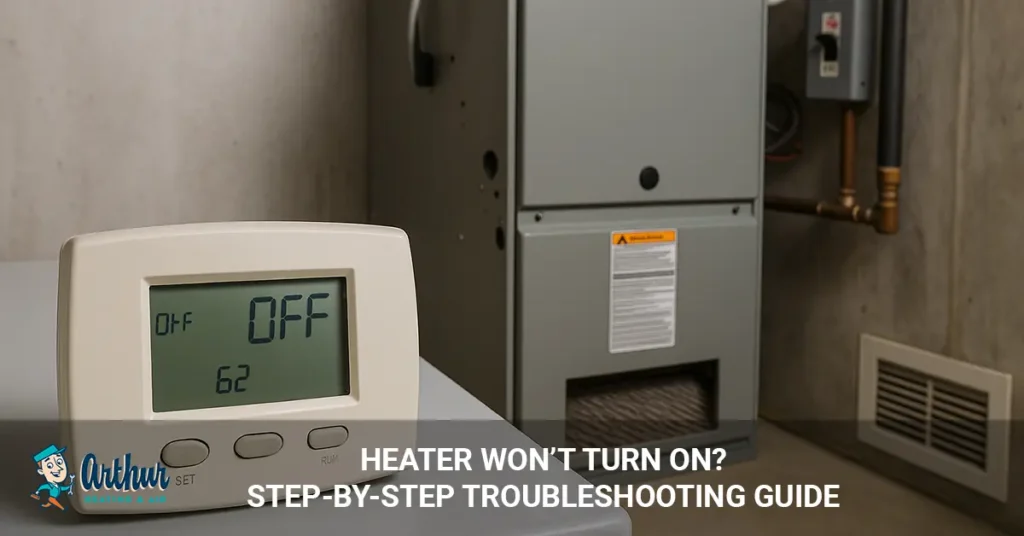
If your furnace isn’t turning on, check the thermostat, power supply, furnace switch, air filter, and access panel first. These simple issues can prevent a furnace from starting. If those checks don’t solve the problem, the cause may involve the ignition system, flame sensor, limit switch, blower motor, or control board.
A furnace that won’t start can have a simple fix. But some problems involve gas, electricity, or safety controls and require professional service.
Here’s how to find the likely cause and what you can safely do before calling an HVAC technician.
Why Is My Furnace Not Turning On?
A furnace may not turn on because of a thermostat problem, power issue, restricted airflow, safety switch, ignition failure, or failed internal component.
Start with the easiest checks before assuming you need a major repair.
| Cause | What You Can Check | Service Needed? |
| Thermostat problem | Mode, temperature, batteries | Usually no |
| Power problem | Breaker and furnace switch | Usually no |
| Dirty air filter | Filter condition | Usually no |
| Furnace door | Panel position | Usually no |
| Clogged condensate drain | Drain and safety switch | Often |
| Ignition problem | Startup behavior | Yes |
| Flame sensor problem | Starts, then shuts off | Yes |
| Limit switch | Overheating or repeated shutdown | Yes |
| Blower problem | No airflow or unusual motor noise | Yes |
| Control board failure | No response from furnace | Yes |
If the furnace doesn’t respond after the basic checks, don’t start removing internal components. A professional can test the system and identify the failed part.
10 Reasons Your Furnace Isn’t Turning On
1. The Thermostat Is Set Incorrectly
A thermostat that’s off, set to the wrong mode, or set below the current room temperature can keep your furnace from starting.
Before calling for service, check the thermostat.
Make sure:
- The mode is set to HEAT.
- The temperature is several degrees above the current room temperature.
- The thermostat has power.
- The batteries work if your thermostat uses them.
Wait a few minutes after changing the setting. Many furnaces have a short startup delay.
If the thermostat works normally but the furnace still doesn’t respond, move on to the power and furnace checks.
2. The Furnace Has No Power
A tripped circuit breaker or turned-off furnace switch can prevent the furnace from starting.
Check your electrical panel for the breaker that supplies the furnace. Also look for the furnace service switch, which often sits near the unit and can resemble a normal light switch.
If the breaker has tripped, you can reset it once.
However, don’t repeatedly reset a breaker that trips again. A repeated trip can indicate an electrical problem that needs professional diagnosis.
If the breaker stays on but the furnace remains completely unresponsive, the problem may be inside the furnace.
3. The Air Filter Is Extremely Dirty
A severely clogged air filter can restrict airflow and cause the furnace to overheat and shut down on a safety control.
Check the filter if you haven’t replaced it recently.
A dirty filter can:
- Restrict airflow
- Increase blower strain
- Reduce heating performance
- Cause the furnace to overheat
- Trigger a safety shutdown
Replace a dirty filter with the correct size and type for your system.
Don’t assume a dirty filter is the cause if a new filter doesn’t solve the problem. Continued shutdowns need professional diagnosis.
4. The Furnace Door Isn’t Closed Properly
Many furnaces won’t operate when the access panel isn’t properly installed because a safety switch can interrupt power to the unit.
Check that the front panel sits correctly in place.
You can safely reposition an accessible panel if it has come loose. Don’t tape, bypass, or otherwise defeat the furnace’s safety switch.
If the furnace still doesn’t operate with the panel properly installed, continue with the other checks.
5. The Condensate Drain Is Clogged
A clogged condensate drain can activate a safety switch and prevent some high-efficiency furnaces from operating.
High-efficiency furnaces create condensation during normal operation. The system drains that water through a condensate line.
When the drain becomes blocked, water can collect in the drain pan or condensate system. A safety switch may then stop the furnace to prevent water damage.
You may notice:
- Water around the furnace
- A full condensate pump
- Repeated furnace shutdowns
- Little or no drainage
- A furnace that won’t start despite a working thermostat
Don’t bypass the condensate safety switch. If you suspect a blocked drain and aren’t comfortable servicing it, call an HVAC technician.
6. The Ignition System Has Failed
A failed ignition system can prevent a gas furnace from lighting even when the thermostat calls for heat.
Modern furnaces use an electronic ignition system rather than a continuously burning pilot light in many installations.
A problem with the igniter, ignition control, or related wiring can interrupt the startup sequence.
You may hear the furnace attempt to start but never produce heat.
Gas and ignition components require proper testing. Don’t attempt to repair or adjust them yourself.
If the furnace has power and the thermostat calls for heat but the burners never ignite, have an HVAC professional inspect the ignition system.
7. The Flame Sensor Is Dirty or Failing
A dirty or failing flame sensor can cause the furnace to ignite briefly and then shut down.
This problem can look like a furnace that won’t turn on because the system may start its heating cycle but shut down almost immediately.
The flame sensor confirms that the burner has successfully ignited. If the control system doesn’t receive the expected signal, it can shut the furnace down as a safety measure.
If your furnace starts for a few seconds and then stops, the flame sensor is one possible cause.
Because the sensor sits inside the furnace and proper diagnosis requires understanding the startup sequence, have a technician inspect it rather than guessing at the repair.
8. The Limit Switch Has Shut the Furnace Down
A furnace limit switch can shut the system down when it detects excessive heat or another unsafe operating condition.
Restricted airflow is one possible reason a furnace overheats.
Common contributors include:
- A severely dirty filter
- Blocked supply vents
- Restricted return airflow
- Blower problems
- Other airflow issues
If the furnace repeatedly shuts down because of a limit condition, don’t keep resetting it and hoping it will run normally.
The underlying cause needs to be identified. Otherwise, the furnace may continue overheating and shutting down.
9. The Blower Motor or Related Component Has Failed
A failed blower motor or related electrical component can prevent the furnace from moving heated air through your home and can interrupt normal operation.
You may notice:
- No airflow from the vents
- A humming sound
- A furnace that starts but doesn’t circulate air
- Repeated shutdowns
- Unusual blower noises
Blower motors and their electrical components require proper testing.
If the furnace starts but you don’t feel air coming from the vents, don’t assume the thermostat or filter is the problem. Have the blower assembly inspected if basic airflow checks don’t solve the issue.
10. The Control Board or Electrical System Has Failed
A failed control board, wiring problem, or other electrical component can prevent the furnace from responding to a call for heat.
The control board coordinates several parts of the furnace during startup and operation.
An electrical problem may cause:
- No response from the furnace
- Intermittent operation
- Random shutdowns
- Blower problems
- Ignition problems
- Error codes
Don’t attempt to test or repair furnace wiring yourself. A technician can use electrical testing equipment to identify the failed component safely.
What Can You Check When Your Furnace Won’t Turn On?
You can safely check the thermostat, power supply, furnace switch, air filter, vents, and access panel before calling an HVAC technician.
Follow this simple checklist:
- Set the thermostat to HEAT.
- Raise the temperature several degrees above the room temperature.
- Check the thermostat batteries if applicable.
- Check the furnace circuit breaker.
- Make sure the furnace service switch is on.
- Check whether the air filter is heavily dirty.
- Make sure supply vents are open.
- Make sure return-air grilles aren’t blocked.
- Check that the furnace access panel sits correctly.
- Give the furnace a few minutes to complete its startup sequence.
These checks can solve simple problems without a service call.
However, don’t open the furnace or attempt to repair internal components.
What You Shouldn’t Try Yourself
Don’t attempt DIY repairs involving gas lines, burners, ignition components, electrical wiring, or furnace safety controls.
Avoid:
- Bypassing safety switches
- Adjusting gas pressure
- Repairing gas connections
- Working on electrical wiring
- Replacing internal controls without proper diagnosis
- Repeatedly resetting a tripped breaker
- Tampering with the ignition system
These components require proper testing and safety procedures.
Why Does My Furnace Turn On but Not Stay On?
A furnace that starts and then shuts off usually has an ignition, flame-sensing, airflow, or overheating problem rather than a simple thermostat issue.
This is different from a furnace that never responds at all. If your furnace is experiencing other recurring issues, our guide to Common Furnace Problems and How to Avoid Them (Homeowner Guide) covers the most common problems homeowners should watch for and how to prevent them.
For example, your furnace may:
- Receive a call for heat.
- Start the blower or ignition sequence.
- Ignite the burner.
- Shut down shortly afterward.
A dirty flame sensor, restricted airflow, limit switch problem, or ignition issue can cause this behavior.
If the furnace repeatedly starts and stops, don’t keep restarting it. A heater that keeps shutting off may have an underlying ignition, airflow, or safety-control problem. The repeated shutdown is a sign that the system needs diagnosis.
When Should You Call an HVAC Technician?
Call an HVAC technician when basic thermostat, power, filter, and airflow checks don’t restore operation or when the problem involves gas, ignition, electrical components, or safety controls. Professional furnace repair can identify the underlying problem and restore safe operation.
Professional service makes sense when:
- The furnace has power but won’t start.
- The furnace repeatedly starts and shuts down.
- The breaker keeps tripping.
- You hear unusual electrical or mechanical noises.
- The furnace produces a burning smell.
- You smell gas.
- The furnace displays an error code.
- You have no heat after basic checks.
- The blower doesn’t operate normally.
- A safety switch repeatedly shuts the system down.
If you smell gas, don’t attempt to diagnose the furnace. Leave the area and follow your local gas utility’s emergency instructions.
How Much Does Furnace Repair Cost?
Furnace repair costs vary widely because the price depends on the failed component, labor, system type, and repair complexity. For a more detailed breakdown, see our guide to furnace repair cost.
A simple thermostat or airflow problem may cost little or nothing if you can correct it yourself.
More involved repairs can cost considerably more, especially when they involve:
- Ignition components
- Blower motors
- Electrical controls
- Control boards
- Safety switches
- Gas-related components
Don’t approve a major repair based only on the symptom. Ask the HVAC technician to explain what failed, why it failed, and what the repair includes.
If the furnace is older and needs a major repair, compare the repair cost with the cost of replacing the system.
Frequently Asked Questions
Why is my furnace not turning on?
A furnace may not turn on because of a thermostat setting, power problem, dirty filter, safety switch, ignition issue, or failed internal component. Start with the thermostat, breaker, furnace switch, filter, and access panel before calling for service.
Why won’t my furnace turn on but the thermostat works?
If the thermostat works but the furnace doesn’t respond, the problem may involve the furnace’s power supply, safety controls, ignition system, or internal electrical components. Check the breaker and furnace switch first.
Why does my furnace have power but won’t start?
A furnace with power but no startup may have an ignition problem, safety-control issue, control board failure, or another internal fault. If the thermostat calls for heat and the furnace remains unresponsive, professional diagnosis may be necessary.
Why does my furnace turn on and then shut off?
A furnace that starts and quickly shuts down may have a dirty flame sensor, restricted airflow, overheating problem, ignition issue, or limit-switch problem. Repeated short cycles should receive professional attention.
Can a dirty filter stop a furnace from working?
Yes, a severely dirty filter can restrict airflow, cause overheating, and trigger a furnace safety shutdown. Replace a dirty filter with the correct size and check whether normal operation returns.
Why is my furnace clicking but not turning on?
Repeated clicking without ignition can indicate an ignition, control, or electrical problem. A brief startup click can be normal, but repeated clicking without heat needs inspection.
Why is my furnace blowing cold air?
A furnace may blow cold air because the burners aren’t operating, the system has a startup problem, or the blower continues running after the heating cycle ends. Check the thermostat and filter first, then call an HVAC technician if the problem continues.
Should I reset my furnace?
You can check and reset a tripped circuit breaker once, but you shouldn’t repeatedly reset a furnace that keeps shutting down. Repeated shutdowns usually indicate an underlying problem that needs diagnosis.
How do I restart my furnace?
Start by checking that the thermostat calls for heat, the furnace switch is on, the breaker hasn’t tripped, and the access panel is properly installed. Don’t attempt to restart or relight internal gas components unless the manufacturer’s instructions specifically allow a homeowner to do so.
When should I call an HVAC technician?
Call an HVAC technician when basic checks don’t restore heat or when you suspect an ignition, gas, electrical, blower, or safety-control problem. Professional service is also appropriate when the furnace repeatedly starts and shuts down.
Final Thought
If your furnace isn’t turning on, start with the thermostat, breaker, furnace switch, air filter, and access panel. These checks can resolve some of the simplest causes without a service call.
If those checks don’t work, the problem may involve the ignition system, flame sensor, limit switch, blower motor, control board, or another internal component.
Don’t bypass safety controls or attempt gas and electrical repairs yourself.
If the furnace has power but still won’t start, or it repeatedly starts and shuts down, have an HVAC professional diagnose the problem.