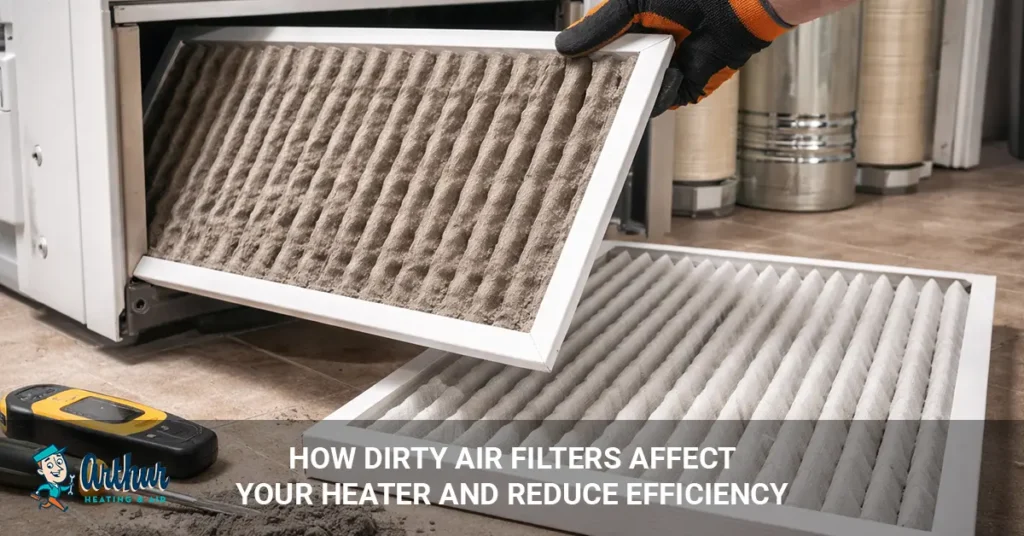
A dirty air filter restricts airflow and makes your heater work harder to warm your home. As the filter fills with dust, the system may run longer, use more energy, heat rooms unevenly, or even overheat.
A severely clogged filter can cause some furnaces to shut down as a safety measure. You may also notice weaker airflow from the vents or longer heating cycles.
The good news is that checking the filter is simple. If it’s dirty, replacing it may restore normal airflow and improve heater performance.
However, if your heater still runs poorly, overheats, or shuts down after you install a clean filter, the problem may be elsewhere in the system.
What Happens When a Heater Has a Dirty Air Filter?
A dirty air filter restricts the amount of air moving through the heater, which can make the system work harder to heat your home.
Your furnace needs steady airflow to operate properly. The return side pulls air from your home through the filter and sends it through the heating system.
As dust and debris build up on the filter, less air can pass through.
That restriction can lead to:
- Weaker airflow from vents
- Longer heating cycles
- Higher energy use
- Uneven heating
- Blower strain
- Furnace overheating
- Safety shutdowns
A slightly dirty filter may only reduce airflow. A severely clogged filter can create much bigger operating problems.
7 Signs Your Heater Air Filter Is Too Dirty
Weak airflow, longer heating cycles, rising energy use, overheating, and a visibly clogged filter are common signs that your heater filter needs attention.
1. Weak Airflow From the Vents
A clogged filter can reduce the amount of warm air reaching your rooms.
You may notice that air coming from the vents feels weaker than usual.
Before assuming the blower motor has failed, check the filter. A heavily loaded filter can restrict the return airflow enough to reduce the air coming through the supply vents.
Also make sure furniture, rugs, and other objects aren’t blocking your return-air grilles or supply vents.
2. Your Heater Runs Longer Than Normal
A dirty filter can make the heater run longer because restricted airflow slows the transfer of warm air into your home.
If your furnace takes much longer than usual to reach the thermostat setting, check the filter.
Long heating cycles can happen for other reasons too. Outdoor temperature, insulation, ductwork, system sizing, and equipment condition can all affect runtime.
A dirty filter is simply one of the easiest things to check first.
3. The Heater Overheats or Shuts Off
A severely restricted filter can contribute to furnace overheating and cause a safety control to shut the system down.
When airflow drops, heat may build up inside the furnace instead of moving efficiently through the ductwork.
A limit switch can shut the furnace down when temperatures become too high.
If the furnace repeatedly shuts down, don’t keep resetting it. Replace a dirty filter first, but call an HVAC technician if the problem continues.
Repeated overheating can indicate a deeper airflow, blower, or furnace problem.
4. Your Energy Bills Increase
A dirty filter can increase heating costs because the system may need to run longer to maintain the desired temperature.
The filter itself doesn’t directly make the furnace consume a specific amount of extra energy.
The problem comes from restricted airflow and longer or less efficient operation.
If your heating bill suddenly increases, don’t automatically blame the filter. Weather, thermostat settings, insulation, duct leaks, and equipment problems can also affect energy use.
Check the filter as part of your initial inspection.
5. Your Home Heats Unevenly
A restricted filter can contribute to uneven heating by reducing overall airflow through the HVAC system.
You may notice:
- Cold rooms
- Weak airflow from some vents
- Rooms taking longer to warm up
- Larger temperature differences between floors
Uneven heating doesn’t always mean the filter is responsible. If you’re experiencing weak airflow in certain rooms, the cause may involve ductwork, airflow, insulation, or system sizing.
Ductwork problems, insulation, air leaks, zoning issues, and system sizing can also cause uneven temperatures.
Start with the simple filter check before assuming you need a major repair.
6. You Notice More Dust Around the Home
A heavily loaded or damaged filter may become less effective at capturing airborne particles as intended.
A filter that’s packed with dust clearly needs attention.
However, don’t assume every increase in household dust comes from the furnace filter. Open windows, construction, pets, cleaning habits, duct leaks, and other sources can also increase indoor dust.
If the filter looks heavily loaded, replace it with the correct filter for your system.
7. The Filter Looks Gray, Dusty, or Clogged
A visibly loaded filter is a clear sign that you should check whether it needs replacement.
Hold the filter up to a light if you’re unsure about its condition. A heavily coated filter that blocks much of the filter material needs attention.
Don’t judge every filter by color alone. Some filters naturally look darker than others because of their material and design.
The safest approach is to follow the filter manufacturer’s replacement guidance and inspect the filter regularly.
How Does a Dirty Air Filter Affect Heater Efficiency?
A dirty filter can reduce heating efficiency by restricting airflow and making the system operate longer to maintain the desired temperature.
A clean filter allows the HVAC system to move air with less resistance.
As the filter becomes clogged, the blower has to move air through a more restricted path. The furnace may then need longer cycles to deliver enough heat to the home.
This can contribute to:
- Longer run times
- Increased blower workload
- Reduced heating performance
- Higher energy consumption
- Greater operating stress
A dirty filter doesn’t automatically mean your furnace has become permanently inefficient.
Replacing the filter can remove the airflow restriction. If the system still performs poorly afterward, have it inspected.
Can a Dirty Filter Cause a Heater to Stop Working?
Yes, a severely dirty filter can contribute to overheating and cause some furnaces to shut down through a safety control.
The furnace has safety controls designed to prevent unsafe operating temperatures.
When airflow becomes too restricted, the furnace may overheat. A limit switch can then interrupt the heating cycle.
You may notice that the furnace:
- Starts normally.
- Produces heat.
- Runs for a while.
- Shuts down.
- Repeats the cycle later.
This pattern can indicate a dirty filter, but it can also point to other airflow or equipment problems.
Replace a dirty filter and monitor the system. If your heater keeps shutting off after you install a clean filter, call an HVAC technician.
Can a Dirty Air Filter Damage a Furnace?
Prolonged airflow restriction can increase stress on furnace components and contribute to overheating or premature wear.
The blower motor has to move air through the system, while the furnace needs sufficient airflow to transfer heat properly.
A severely restricted filter can contribute to problems involving:
- Blower operation
- Furnace overheating
- Limit-switch cycling
- Heat exchanger stress
- Overall system performance
That doesn’t mean one missed filter change will damage your furnace.
The bigger concern is long-term operation with a severely restricted filter.
Replacing the filter regularly is a simple way to reduce unnecessary airflow problems.
Still Noticing Weak Airflow or Uneven Heating?
A professional check can restore efficiency and prevent costly repairs.
 Book a Heater Efficiency Check
How Often Should You Change a Heater Air Filter?
Many residential HVAC filters need replacement every 1 to 3 months, but the right schedule depends on the filter, home conditions, pets, occupancy, and system use. For more guidance, see how often to replace your HVAC air filter.
A practical starting point looks like this:
| Home Condition | Typical Filter Check |
| One person, no pets | Every 2–3 months |
| Family household | Every 1–2 months |
| Multiple pets | About monthly |
| High dust levels | Check more frequently |
| Allergy-sensitive household | Check frequently and follow filter guidance |
These are general guidelines, not fixed rules.
A filter can load faster in a home with several pets, construction dust, frequent occupancy, or other sources of airborne particles.
The easiest habit is to check the filter regularly rather than relying only on a calendar reminder. Filter checks are also an important part of a full HVAC maintenance checklist.
How to Check and Replace a Heater Air Filter
You can usually check and replace a standard HVAC filter yourself as long as you use the correct size and install it in the proper direction.
Follow these steps:
- Turn the heater off.
- Locate the air filter.
- Check the size printed on the filter frame.
- Remove the old filter.
- Check the airflow arrow.
- Install the new filter with the arrow pointing in the correct direction.
- Make sure the filter fits securely.
- Turn the system back on.
Don’t force a filter into the slot if it doesn’t fit.
An incorrectly sized or incorrectly installed filter can create its own airflow problems.
If you’re unsure which filter your system requires, check the existing filter, furnace documentation, or ask an HVAC professional.
Can a Dirty Filter Cause Other Heater Problems?
A dirty filter can contribute to several heating problems because restricted airflow affects how the entire system operates.
Possible effects include:
- Short cycling
- Weak airflow
- Longer heating cycles
- Furnace overheating
- Blower strain
- Uneven heating
- Safety shutdowns
Not every heater problem comes from the filter. Other common furnace problems can also cause shutdowns, airflow issues, and poor heating performance.
For example, a furnace that repeatedly shuts off with a clean filter may have a blower problem, limit-switch issue, ignition problem, duct restriction, or another fault.
That’s why replacing the filter should be treated as a first check, not a complete diagnosis.
When Should You Call an HVAC Technician?
Call an HVAC technician if your heater continues to perform poorly after you replace a dirty filter or if the system repeatedly overheats, shuts down, or makes unusual noises.
Professional service, including air filter replacement when needed, is appropriate when:
- The furnace keeps short cycling.
- The furnace repeatedly shuts down.
- Airflow remains weak with a clean filter.
- The blower doesn’t operate correctly.
- You smell gas.
- You notice a burning odor.
- The system makes unusual mechanical noises.
- The filter becomes extremely dirty again very quickly.
- You suspect a ductwork or internal furnace problem.
A filter that becomes dirty unusually fast can also point to excessive dust, airflow problems, or other conditions worth investigating.
Frequently Asked Questions
Can a dirty filter make a heater stop working?
Yes, a severely dirty filter can restrict airflow, cause overheating, and trigger a furnace safety shutdown. Replace the filter and check whether normal operation returns. If the furnace still won’t run properly, call an HVAC technician.
Can a dirty filter cause a furnace to overheat?
Yes, restricted airflow from a severely clogged filter can contribute to furnace overheating. The furnace may then shut down through a safety control to prevent excessive temperatures.
Does a dirty air filter make heating bills higher?
A dirty filter can increase heating costs by restricting airflow and causing the system to run longer. However, rising energy bills can also result from weather, insulation, ductwork, thermostat settings, or equipment problems.
How often should I change my heater filter?
Many HVAC filters need replacement every 1 to 3 months, but some require more frequent changes. Check the filter regularly and follow the manufacturer’s recommendations.
What happens if I don’t change my furnace filter?
A neglected filter can become increasingly restrictive, reducing airflow and potentially contributing to longer heating cycles, overheating, and increased system stress.
Can a dirty filter cause short cycling?
Yes, a severely restricted filter can contribute to short cycling by reducing airflow and causing the furnace to overheat. If short cycling continues after replacing the filter, the system needs professional diagnosis.
Can a dirty filter damage a furnace?
Long-term operation with a severely restricted filter can increase stress on furnace components and contribute to premature wear. Regular filter replacement helps maintain proper airflow.
How do I know if my furnace filter needs changing?
A visibly loaded filter, reduced airflow, longer heating cycles, or repeated furnace shutdowns can indicate that the filter needs attention. Checking the filter regularly is the simplest way to know.
Does a dirty filter affect heater airflow?
Yes, a clogged filter can restrict the amount of air moving through the HVAC system and reduce airflow from the supply vents.
Will changing the filter make my heater work better?
Replacing a severely dirty filter can improve airflow and help the heater operate more normally. If the system still has weak airflow, overheating, or short-cycling problems with a clean filter, another issue may be present.
Final Thought
A dirty air filter can restrict airflow, make your heater run longer, increase energy use, and contribute to overheating. In severe cases, the furnace may shut down on a safety control.
The simplest solution is also one of the easiest: check your filter regularly and replace it when it becomes loaded with dust or reaches the manufacturer’s recommended replacement interval.
If your heater continues to short cycle, overheat, provide weak airflow, or shut down after you install a clean filter, don’t keep replacing filters and hoping the problem disappears.
A clean filter should improve airflow. If it doesn’t, the heater may have another problem that needs professional diagnosis.
Keep Your Heater Running Efficiently All Winter
Schedule maintenance to prevent breakdowns and lower energy costs.
 Schedule Heating Maintenance