
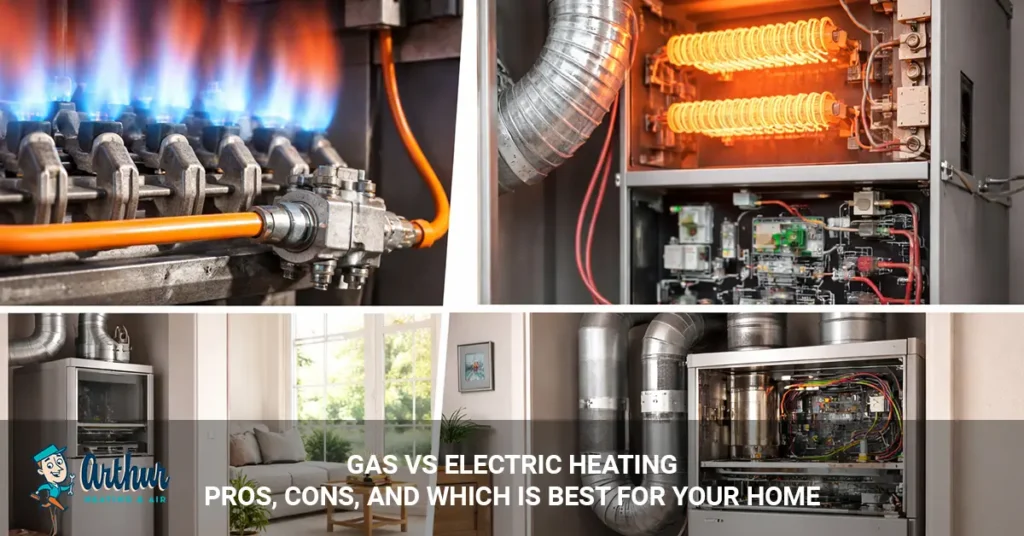
Gas heating can be a good choice where natural gas is affordable and already available, while electric heating can make more sense when gas service isn’t available or electricity rates and equipment efficiency work in your favor.
The better option depends on more than the fuel source. Local energy prices, equipment efficiency, installation costs, climate, and your home’s existing HVAC setup all affect the decision.
There’s also an important distinction within electric heating. An electric resistance furnace doesn’t perform the same way as a heat pump. A heat pump moves heat rather than creating it directly, which can make it much more efficient for heating.
Here’s how gas and electric heating compare on cost, efficiency, maintenance, safety, and long-term value.
Gas vs. Electric Heating: Which Is Better?
Gas heating may be better for homes with affordable natural gas and existing gas infrastructure, while electric heating can be better for homes without gas service or homeowners who prefer electric equipment.
| Factor | Gas Heating | Electric Heating |
| Energy source | Natural gas | Electricity |
| Upfront cost | Varies | Varies |
| Operating cost | Depends on gas rates | Depends on electric rates |
| Combustion | Yes | No |
| Venting | Required for gas combustion | Generally not required |
| Installation | Can be more complex | Often simpler |
| Maintenance | More combustion components | Generally fewer components |
| Heating equipment | Furnace or boiler | Furnace, baseboard, or heat pump |
| Best fit | Homes with gas service | Homes without gas or with suitable electric rates |
There isn’t one answer that works for every home.
A homeowner with an existing gas line and affordable natural gas may get better operating costs from a gas furnace. Someone without gas service may find electric heating much simpler to install.
Gas vs. Electric Heating Cost
The cheaper heating option depends on local gas and electricity prices, equipment efficiency, and how much heating your home needs.
Comparing the price per unit of energy alone doesn’t tell you which system will cost less to operate.
You also need to consider how efficiently the equipment converts or moves that energy into usable heat.
Gas Heating Operating Cost
Gas heating can cost less to operate where natural gas prices are relatively low and the furnace has good efficiency.
A gas furnace burns natural gas to produce heat and then distributes that heat through the home’s ductwork.
Your operating cost depends on:
- Natural gas rates
- Furnace efficiency
- Home size
- Outdoor temperatures
- Thermostat settings
- Heating runtime
- Insulation and air leakage
A high-efficiency gas furnace can use less fuel than an older, inefficient model to provide the same amount of heat.
Electric Heating Operating Cost
Electric heating costs depend heavily on electricity rates and the type of electric heating system you use.
This distinction matters.
Electric resistance heating uses electricity to create heat. Heat pumps use electricity to move heat from one location to another.
A resistance heater can have very different operating costs from a modern heat pump even though both use electricity.
Gas vs. Electric Heating: Cost Comparison
| Cost Factor | Gas | Electric |
| Energy source | Natural gas | Electricity |
| Fuel price | Local gas rate | Local electric rate |
| Equipment | Furnace or boiler | Furnace, baseboard, or heat pump |
| Installation | Can require gas line and venting | May require electrical upgrades |
| Maintenance | More combustion-related components | Generally simpler |
| Operating cost | Often favorable where gas is inexpensive | Varies widely by system |
The best way to compare the two for your home is to use your actual utility rates and expected annual heating demand. You can also look at strategies to lower heating and cooling bills when comparing long-term operating costs.
Gas Heating Pros and Cons
Gas heating provides strong heating output and can have favorable operating costs, but it requires combustion equipment, venting, and a natural gas supply.
Pros of Gas Heating
Gas furnaces can heat a home quickly and provide strong heating output during cold weather.
Other advantages include:
- Natural gas can be relatively inexpensive in some areas.
- High-efficiency gas furnaces are widely available.
- Existing gas infrastructure can simplify installation.
- Gas furnaces work well with conventional duct systems.
- Modern equipment can provide reliable heating when properly maintained.
If your home already has a gas line and a suitable furnace setup, replacing an existing gas furnace can also be more straightforward than switching fuel sources.
Cons of Gas Heating
Gas heating requires combustion, which adds components and safety considerations that electric systems don’t have.
Potential disadvantages include:
- Natural gas service is required.
- Gas lines may need installation or modification.
- Combustion requires proper venting.
- Heat exchangers and burners need inspection.
- Gas systems can produce carbon monoxide if combustion or venting problems occur.
- Installation can be more complex when a home doesn’t already have gas service.
Proper installation and maintenance are important for safe operation.
Electric Heating Pros and Cons
Electric heating can simplify installation and avoids combustion inside the home, but operating costs vary considerably depending on the system and electricity rate.
Pros of Electric Heating
Electric heating doesn’t require a gas supply or combustion equipment.
Other advantages include:
- No gas line required.
- No combustion inside the home.
- No combustion exhaust from an electric resistance heater.
- Installation can be straightforward for some systems.
- Electricity is widely available.
- Heat pumps can provide both heating and cooling.
Electric heating can be especially practical for homes that don’t already have natural gas service.
Cons of Electric Heating
Electric resistance heating can cost more to operate than gas heating in areas with high electricity prices and affordable natural gas.
Other considerations include:
- Electricity rates vary by location.
- Resistance heating can use substantial electricity during cold weather.
- An older electrical panel may need an upgrade.
- Different electric heating systems have very different efficiency and operating costs.
- Heat pumps may require backup heat during certain cold conditions.
This is why you shouldn’t compare “gas” with “electric” without identifying the specific electric system.
Gas Furnace vs. Electric Furnace
Gas and electric furnaces both use ductwork to distribute warm air, but a gas furnace burns fuel while an electric furnace uses heating elements.
| Feature | Gas Furnace | Electric Furnace |
| Energy source | Natural gas | Electricity |
| Heat production | Gas combustion | Electric resistance |
| Combustion | Yes | No |
| Venting | Required | Generally not |
| Gas connection | Required | Not required |
| Maintenance | More components | Generally simpler |
A gas furnace may make sense when gas service already exists and local gas rates are favorable.
An electric furnace may be practical when gas isn’t available or when installation simplicity matters.
However, if you’re considering electric heating primarily for efficiency, compare an electric furnace with a heat pump before making a decision.
Gas Furnace vs. Heat Pump
A heat pump can use electricity much more efficiently than an electric resistance furnace because it moves heat instead of generating heat directly. See our comparison of heat pump vs. furnace for a closer look at how the two systems differ.
This makes the comparison more complicated than simply saying gas is cheaper or electric is cheaper.
A heat pump transfers heat between the outdoors and your home. It can also reverse its operation to provide cooling.
An electric furnace, by comparison, uses electric resistance elements to generate heat.
Depending on your climate, electricity rates, heat-pump efficiency, and gas prices, a heat pump can be an attractive alternative to both gas and electric resistance heating.
Which Is Cheaper to Install: Gas or Electric?
Electric heating can be simpler to install when a home already has adequate electrical service, while gas heating may cost more when gas lines and venting need to be added.
Installation costs depend heavily on the existing home. Professional heater installation and replacement can also vary depending on the existing gas, electrical, ductwork, and equipment setup.
A gas installation may involve:
- Gas-line work
- Venting
- Combustion-air requirements
- Furnace installation
- Ductwork modifications
An electric installation may involve:
- Electrical circuit upgrades
- Panel capacity
- Furnace or heat-pump installation
- Ductwork changes
- Equipment-specific requirements
If your home already has a gas furnace and gas connection, staying with gas may require less infrastructure work.
If your home doesn’t have gas service, installing a new gas line can change the economics significantly.
Which Is Cheaper to Run: Gas or Electric?
Gas may cost less to operate where natural gas is inexpensive, but a high-efficiency heat pump can be competitive or cheaper depending on local electricity and gas prices.
This is why national rules of thumb don’t always work.
To compare heating costs, look at:
- Your electricity rate.
- Your natural gas rate.
- The efficiency of each system.
- Your home’s annual heating demand.
- Installation and maintenance costs.
- Expected equipment life.
For electric heating, also identify whether you’re comparing resistance heating or a heat pump.
That distinction can completely change the operating-cost comparison.
Which Heating System Is More Efficient?
Heat pumps generally deliver more heat per unit of electricity than electric resistance systems, while modern gas furnaces can also achieve high efficiency.
Gas furnace efficiency is commonly expressed using AFUE, or Annual Fuel Utilization Efficiency.
For example, a furnace with a 95% AFUE rating converts about 95% of the fuel’s energy into usable heat over the rating conditions.
Heat pumps use different performance measurements, including COP, or coefficient of performance.
Because these systems use different technologies and measurements, you shouldn’t compare an AFUE percentage directly with a heat-pump COP.
More importantly, look at how much it costs to operate the equipment in your home.
Which Heating System Lasts Longer?
Both gas and electric heating systems can last many years, and installation quality, maintenance, equipment quality, and usage often matter more than the energy source alone.
A furnace that receives regular maintenance and operates under appropriate conditions may last much longer than a poorly installed system. Our guide to home heater lifespan explains the factors that can affect how long heating equipment lasts.
Factors that affect service life include:
- Installation quality
- Equipment quality
- Annual runtime
- Maintenance
- Airflow
- System sizing
- Repair history
Electric resistance furnaces generally have fewer combustion-related components than gas furnaces, but that doesn’t mean every electric system will automatically last longer.
Which Heating System Requires More Maintenance?
Gas heating generally requires more combustion-related maintenance, while electric heating systems often have fewer components that require this type of service.
Gas furnaces have components such as:
- Burners
- Ignition systems
- Heat exchangers
- Gas valves
- Venting
- Flame sensors
Electric systems don’t have gas burners or combustion exhaust.
However, electric systems still need maintenance. Regular heater maintenance can help keep heating equipment operating properly and identify developing problems. Blower motors, electrical connections, filters, controls, coils, and other components can develop problems.
A heat pump also has both heating and cooling functions, so its maintenance needs differ from those of a basic electric furnace.
Is Gas or Electric Heating Safer?
Both gas and electric systems can operate safely when properly installed and maintained, but gas heating has additional combustion and carbon monoxide considerations.
Gas furnaces require proper combustion and venting.
A problem with combustion or exhaust can create a carbon monoxide hazard.
Homes with fuel-burning appliances should have properly installed carbon monoxide alarms and should follow local safety requirements.
Electric heating doesn’t produce carbon monoxide through combustion because it doesn’t burn fuel inside the home.
That doesn’t make electrical systems risk-free. Electrical equipment still requires proper installation, wiring, circuit protection, and maintenance.
Which Is Better for Your Home?
The better heating system depends on your local energy prices, existing utility connections, climate, installation costs, and the type of heating you prefer. You can also compare the best heating systems for Texas homes based on your home’s needs.
Choose Gas Heating If:
Gas heating may make sense if your home already has natural gas service and local gas prices make operation affordable.
It can also be a good fit when:
- You already have a gas furnace.
- Your ductwork is in good condition.
- Gas service is readily available.
- You want strong heating output.
- Gas operating costs are favorable in your area.
Choose Electric Heating If:
Electric heating may make sense if your home doesn’t have natural gas service or you prefer to avoid combustion equipment.
Consider it when:
- Gas isn’t available.
- Electrical service is adequate.
- Installation would be simpler.
- You want to eliminate combustion equipment.
- Local electricity rates make electric heating practical.
Consider a Heat Pump If:
A heat pump is worth considering if you want electric heating and cooling in one system with high heating efficiency.
A heat pump may be a particularly attractive option when:
- You want both heating and cooling.
- Electricity rates are favorable.
- Your climate suits heat-pump operation.
- Energy efficiency is a priority.
- You’re replacing an aging HVAC system.
If you’re comparing a gas furnace with electric heating, make sure the electric option includes a heat pump in the comparison.
Frequently Asked Questions
Is gas heating cheaper than electric heating?
Gas heating can cost less to operate than electric resistance heating where natural gas is inexpensive, but the answer depends on local energy rates and equipment efficiency. A high-efficiency heat pump can change the comparison significantly.
Is electric heating more efficient than gas?
Electric resistance heating converts electricity into heat very efficiently, while heat pumps can deliver several times more heat energy than the electricity they consume under suitable conditions. Gas furnace efficiency depends on its AFUE rating.
Is gas or electric heating better for a house?
Gas may be better for a home with existing gas service and favorable gas rates, while electric heating may be better when gas isn’t available or a homeowner prefers electric equipment. A heat pump can also be an efficient electric option.
Which costs more to install, gas or electric heating?
Gas heating can cost more to install when a home needs new gas lines and venting, while electric heating may require electrical upgrades. Existing infrastructure can make a major difference.
Which is cheaper to run, a gas furnace or electric furnace?
A gas furnace may cost less to run than an electric resistance furnace when natural gas is relatively inexpensive, but local utility rates and equipment efficiency determine the actual difference.
Is electric heating safer than gas?
Electric heating avoids combustion and carbon monoxide risks associated with fuel-burning equipment, while both systems can operate safely when properly installed and maintained.
Does electric heating cost more than gas?
Electric heating doesn’t always cost more than gas because operating costs depend on electricity rates, gas prices, and equipment efficiency. Heat pumps can also make electric heating significantly more efficient than resistance heating.
Is a heat pump cheaper than gas heating?
A heat pump can cost less to operate than gas heating in some homes, but the result depends on local electricity and gas rates, climate, and heat-pump efficiency.
Which heating system lasts longer?
Neither gas nor electric heating automatically lasts longer because equipment quality, installation, maintenance, and usage strongly affect service life.
Should I replace my gas furnace with electric heating?
Switching from gas to electric can make sense when your gas furnace is aging, electricity rates are favorable, or you want to move to a heat pump. Compare installation costs, operating costs, and your home’s electrical capacity before switching.
Final Thought
Gas heating and electric heating can both be good choices, but the better option depends on your home and local energy costs.
Gas can make sense when you already have natural gas service and gas prices are favorable. Electric heating can be practical when gas isn’t available or you want to avoid combustion equipment.
If you’re considering electric heating, don’t overlook heat pumps. They work differently from electric resistance furnaces and can provide much higher heating efficiency under suitable conditions.
Before choosing a system, compare installation cost, energy rates, equipment efficiency, maintenance, and expected heating demand. That gives you a much more useful answer than simply asking whether gas or electricity is cheaper.