
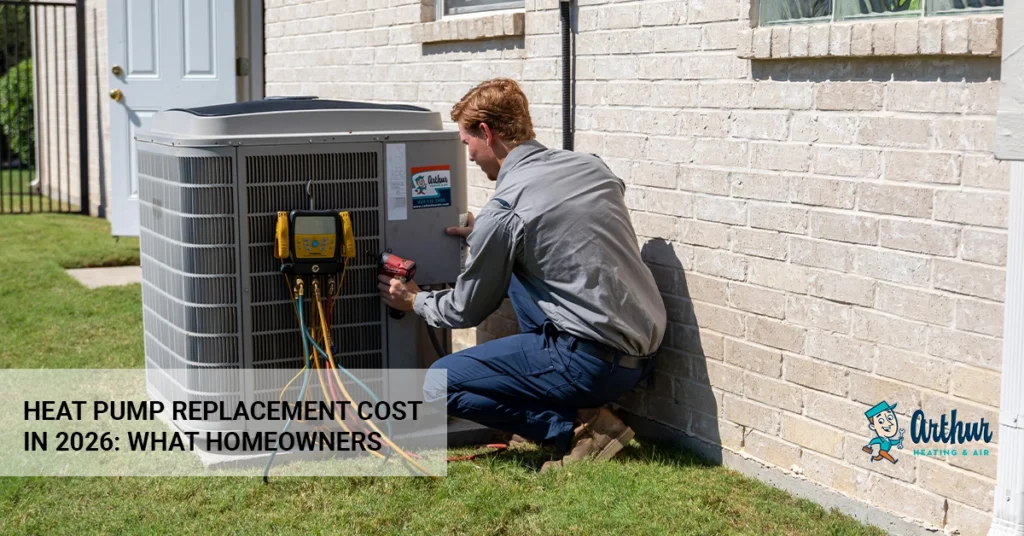
Replacing a heat pump in 2026 typically costs around $7,400 to $15,600 for many standard systems, including installation. However, the final price can range from approximately $6,000 to $25,000 depending on the equipment, system size, efficiency, and installation requirements.
Trane’s 2026 pricing guide lists national heat pump replacement estimates of 7,369–15,608, while Carrier gives a broader installed price range of 6,000–25,000. These figures differ because equipment choices and project requirements vary. Your actual replacement cost will depend on your home and the work involved.
If your current heat pump needs frequent repairs, struggles to maintain comfortable temperatures, or causes rising energy bills, replacing it may be worth considering. Understanding the costs before requesting an estimate can help you compare options and avoid unexpected expenses.
How Much Does Heat Pump Replacement Cost in 2026?
Most homeowners should start by budgeting approximately $7,400– $15,600 for a standard heat pump replacement, using Trane’s published national estimates as a planning benchmark. More complex projects or premium systems may cost considerably more.
If you’re comparing replacement expenses with the cost of installing a new system, our guide to heat pump installation cost explains the factors that affect the overall price.
The table below summarizes current published pricing.
| Replacement cost category | Estimated price |
| Lower-cost standard heat pump options | $7,369– $8,910 |
| Mid-range heat pump options | $9,921– $12,648 |
| Premium heat pump options | $12,778– $15,608 |
| Broader market range reported by Carrier | $6,000– $25,000 |
Source: Trane’s 2026 HVAC Replacement Cost Guide and Carrier’s 2026 Heat Pump Cost Guide. Prices are national estimates, not guaranteed quotes for every home.
These ranges are useful for initial budgeting, but they should not be treated as interchangeable quotes. The exact equipment, installation scope, accessories, and required modifications can change the total.
For example, replacing an existing system with compatible equipment may cost less than a project that requires new refrigerant lines, electrical upgrades, or ductwork repairs.
Heat Pump Replacement Cost by System Type
The type of heat pump you choose has a significant impact on the replacement price. Different systems require different equipment, installation methods, and supporting components.
If you’re considering a different heating system, our guide to heat pump vs. furnace compares the two options to help you understand which may suit your home.
Air-Source Heat Pump Replacement Cost
Replacing an air-source heat pump typically costs several thousand dollars, with many standard replacements falling within the $7,400–$15,600 installed range reported in Trane’s national pricing guide. Your actual cost may be lower or higher depending on the system size, equipment choice, and installation work required.
Air-source heat pumps use outdoor air to heat and cool your home. If you’re replacing an existing system, you may save money when your ductwork, refrigerant lines, and electrical connections are still in good condition.
The type of equipment you choose also affects the price. Basic models generally cost less upfront, while high-efficiency systems with variable-speed compressors and advanced controls can cost more.
Before accepting a quote, check whether it includes the outdoor unit, indoor air handler, labor, old equipment removal, and any necessary upgrades. Trane’s HVAC replacement cost guide provides a national pricing benchmark, but a local contractor can give you a more accurate estimate based on your home and existing equipment.
Ductless Mini-Split Heat Pump Replacement Cost
Replacing a ductless mini-split heat pump typically costs $3,000–$7,500 for a single-zone system and $6,500–$15,000 or more for a multi-zone system, including installation. Your final cost depends on the number of indoor units, system capacity, equipment quality, and installation requirements.
Ductless mini-splits provide heating and cooling without traditional ductwork. They’re a practical choice for home additions, converted garages, and rooms that need independent temperature control.
The biggest cost difference usually comes down to the number of units being replaced. A single-zone system has one indoor unit connected to an outdoor unit, while a multi-zone system serves several rooms. Longer refrigerant lines, difficult mounting locations, and electrical upgrades can also increase the price.
Before approving a replacement, make sure your estimate includes the outdoor unit, all required indoor units, installation labor, removal of the old equipment, and any necessary upgrades. If your existing electrical connections and refrigerant lines are compatible with the new system, you may be able to avoid some additional expenses.
Keep in mind that these are general U.S. price estimates. Your actual replacement cost will depend on your location, equipment choice, and the condition of your existing system.
Geothermal Heat Pump Replacement Cost
Replacing a geothermal heat pump typically costs $6,000–$15,000 or more, including installation, depending on the system size, equipment choice, and condition of the existing ground loop. If the underground piping needs major repairs or replacement, the total cost can rise significantly.
Geothermal heat pumps use the relatively stable temperature of the ground to heat and cool your home. When replacing an existing system, you may save money if the underground loop and its connections are still in good condition.
The biggest cost factor is whether you need to replace only the heat pump unit or repair the ground loop as well. Replacing the indoor equipment is generally less expensive than installing new underground piping, which can require excavation and additional labor.
Before approving the work, ask your HVAC contractor to inspect the existing system and provide an itemized estimate. Make sure the quote separates equipment, labor, ground-loop repairs, and any other additional costs.
Keep in mind these are general U.S. price estimates. Your actual replacement cost will depend on the system’s condition, equipment requirements, and local labor rates.
High-Efficiency Heat Pump Replacement Cost
Replacing a high-efficiency heat pump typically costs $8,000– $18,000 or more, including installation, depending on the system size, efficiency rating, and installation requirements. Premium models with variable-speed compressors and advanced controls can cost more than standard systems.
High-efficiency heat pumps use less energy under suitable operating conditions, which can help lower your heating and cooling bills. However, the actual savings depend on your home’s energy use, local electricity rates, climate, and the efficiency of your old system.
Before choosing a more expensive model, compare its upfront price with a standard heat pump. Ask your HVAC contractor to estimate the annual operating costs of both options. This will help you decide whether the potential energy savings justify the higher purchase price.
Also, check the equipment warranty and whether the new system will work with your existing air handler, ductwork, and thermostat. These details can affect both the replacement cost and the system’s long-term value.
Keep in mind these are general U.S. installed-price estimates. Your actual cost will depend on the equipment you choose and the work your home requires.
What Factors Affect Heat Pump Replacement Cost?
Heat pump replacement cost mainly depends on the system’s size, equipment efficiency, labor, and the condition of your existing setup. Electrical upgrades, ductwork repairs, and other installation work can also increase the final price.
1. Heat Pump Size and Capacity
Larger heat pumps generally cost more than smaller models, but the right size depends on your home’s heating and cooling needs.
Your contractor should consider your home’s square footage, insulation, windows, layout, and local climate before recommending a system. These factors help determine how much heating and cooling capacity your home needs.
Choosing a system that’s too large can lead to higher upfront costs and poor temperature control. A system that’s too small may struggle to keep your home comfortable during extreme weather.
Ask your contractor to perform a Manual J load calculation before selecting a replacement. This helps determine the appropriate system size instead of relying on square footage alone.
2. Equipment Efficiency and Features
High-efficiency heat pumps usually cost more upfront than standard models, but they may help reduce your energy bills over time.
The price depends on the heat pump’s efficiency rating, compressor type, and available features. Models with variable-speed compressors and advanced controls often cost more than basic systems.
However, paying more for a high-efficiency model doesn’t always mean you’ll save enough on energy bills to justify the extra cost. Your savings depend on local electricity rates, your climate, how often you run the system, and the efficiency of your old heat pump.
When comparing replacement options, ask your HVAC contractor for the model numbers, efficiency ratings, and estimated operating costs of each system. This makes it easier to compare the upfront price with potential long-term savings.
3. Installation Labor and Complexity
Heat pump replacement labor costs depend on how much work the installation requires and whether your existing equipment and connections can be reused.
Replacing an existing unit with a compatible system is usually more straightforward than a job that requires electrical upgrades, refrigerant line changes, or ductwork repairs. Difficult access to the indoor or outdoor unit can also increase labor costs.
Your estimate should clearly explain what’s included in the labor charge. Check whether it covers removing the old heat pump, installing the new equipment, connecting the components, testing system operation, and cleaning up the work area.
Before approving the quote, ask your contractor to list any additional work separately. This helps you understand the total replacement cost and avoid unexpected charges.
4. Ductwork and Refrigerant Lines
Ductwork repairs or refrigerant line replacement can increase heat pump replacement costs when the existing components are damaged, leaking, or incompatible with the new system.
If your ducts are in good condition and the refrigerant lines meet the new equipment’s requirements, you may be able to reuse them. However, leaking ducts, damaged insulation, or unsuitable line sets may need repairs or replacement.
These issues can affect system performance and add to the installation cost. Ask your HVAC contractor to inspect the existing components and explain which repairs are necessary before adding them to the estimate.
5. Electrical Work and Thermostat Upgrades
Electrical upgrades and thermostat replacement can add to your heat pump replacement cost if your existing setup isn’t compatible with the new equipment.
Some heat pumps require different wiring, circuit protection, or electrical disconnects. You may also need a new thermostat if your current controls don’t support the replacement system’s features.
Not every installation requires these upgrades. Before approving the work, ask your contractor to identify any electrical changes, control upgrades, and their individual costs in the estimate.
6. Permits, Removal, and Disposal
Permits, old equipment removal, and disposal can add to your total heat pump replacement cost, depending on local requirements and what’s included in your contractor’s quote.
Some contractors include removing and disposing of the old unit in their standard replacement price. Others may list these services separately. Permit fees and inspections can also vary by location and project scope.
Before accepting an estimate, confirm whether it includes the necessary permits, old equipment removal, disposal, and final system testing. Comparing these details helps you understand the full cost and avoid unexpected charges.
What Is Included in a Heat Pump Replacement Estimate?
A heat pump replacement estimate typically includes the new equipment, installation labor, and removal of the old unit, but some items may cost extra. Always check what’s covered before comparing quotes from different HVAC contractors.
A typical estimate may include:
- New heat pump equipment: The outdoor unit and any required matching components.
- Indoor air handler or coil: A new indoor unit or coil if the existing component isn’t compatible or needs replacement.
- Old equipment removal: Disconnecting and removing the existing heat pump.
- Installation labor: Installing the new system and connecting the required components.
- Refrigerant line work: Inspecting the existing lines and repairing or replacing them when necessary.
- System testing: Checking system operation, airflow, controls, and heating and cooling performance.
- Cleanup and disposal: Removing installation debris and disposing of the old equipment properly.
- Permits and additional work: Permit fees, electrical upgrades, ductwork repairs, or other work required for the project.
What Can Increase the Final Estimate?
Your final bill may be higher if the installation requires a new thermostat, electrical upgrades, duct repairs, additional refrigerant line work, or other modifications. These expenses aren’t necessary for every replacement, so ask your contractor to explain why each additional item is needed.
How to Compare Heat Pump Replacement Quotes
Ask each contractor for an itemized estimate that lists the equipment model, installation labor, included components, additional charges, and warranty coverage. Also, confirm whether the price includes permits, removal, and disposal.
Comparing quotes with the same scope of work makes it easier to understand the real cost and avoid choosing a lower-priced estimate that leaves out essential services.
Heat Pump Replacement Cost vs. Repair Cost
Repairing a heat pump usually costs less upfront, but replacing it may offer better long-term value if the system is old, breaks down frequently, or has become expensive to operate. The right choice depends on the repair estimate, the condition of your equipment, and the cost of a new system.
Before deciding to replace your system, review our guide to heat pump repair costs to understand what you might spend on repairs.
A minor repair may be worthwhile if your heat pump is relatively new and works well otherwise. However, if you’re facing a major repair or repeated breakdowns, compare the repair cost with the price of a full replacement before making a decision.
| Factor | Repair may make sense when | Replacement may make sense when |
| System age | The heat pump is relatively new | The system is older and nearing the end of its useful life |
| Repair history | Problems are occasional | Breakdowns happen frequently |
| Repair cost | The fault is inexpensive to fix | A major repair makes replacement worth considering |
| Energy bills | Operating costs remain reasonable | The system has become less efficient and costs more to run |
| Home comfort | The system heats and cools your home properly | It struggles to maintain comfortable temperatures |
When Should You Replace Your Heat Pump Instead of Repairing It?
Consider replacing your heat pump if it is more than 10 years old and needs frequent repairs, has rising operating costs, or struggles to keep your home comfortable. Age alone doesn’t mean you need a new system, but it makes the cost comparison more important.
If your system struggles to keep your home warm, learn about common reasons a heat pump is not heating properly before deciding whether replacement is necessary.
Before deciding, ask your HVAC contractor to provide both a repair estimate and a replacement quote when practical. Compare the immediate repair cost, the likelihood of future repairs, the new system’s expected operating costs, and the warranty coverage.
Choosing the cheapest option today may not save you money over time. A clear comparison can help you decide whether repairing your existing heat pump or investing in a replacement makes more financial sense.
How to Reduce Heat Pump Replacement Costs in 2026
You can reduce your heat pump replacement costs by comparing detailed quotes, choosing the right system size, reviewing long-term operating costs, and checking available incentives. The goal is to save money without sacrificing comfort, efficiency, or installation quality.
Compare Itemized Quotes
Get estimates from at least two or three qualified HVAC contractors before choosing a replacement system. Compare the equipment, installation labor, warranty coverage, and any additional charges included in each quote.
The lowest quote is not always the best value. It may exclude necessary components, electrical work, or other installation requirements. Ask each contractor to explain what the price covers so you can compare estimates fairly.
Choose the Correct System Size
Choosing the correct heat pump size helps you avoid paying for unnecessary capacity while ensuring your system can meet your home’s heating and cooling needs.
Ask your contractor to assess your home’s square footage, insulation, windows, layout, and local climate before recommending a system. A professional load calculation can help determine the appropriate capacity. An oversized or undersized unit may affect comfort, efficiency, and long-term operating costs.
Compare Efficiency Against Operating Costs
A heat pump with a lower purchase price may save you money upfront, while a more efficient model may reduce energy use over time. The better option depends on your climate, electricity rates, heating and cooling habits, and the efficiency of your current system.
Compare the efficiency ratings and estimated operating costs of the models you’re considering. Ask your contractor to explain the expected energy use rather than relying on general promises about savings.
Check Available Incentives
State programs, local governments, and utility providers may offer rebates or other incentives for qualifying heat pump installations. Availability depends on your location, the equipment you choose, and the program’s eligibility requirements.
Important for 2026: Do not assume the former federal Energy Efficient Home Improvement Credit is available for a heat pump installed in 2026. The IRS states that qualifying property placed in service after December 31, 2025, is not eligible for that credit under the applicable rules. Check current state and utility programs for other potential savings.
Review the IRS Energy Efficient Home Improvement Credit guidance for details.
Review Warranty Coverage
Compare the manufacturer’s equipment warranty with any labor warranty offered by the HVAC contractor. Check how long each warranty lasts, whether registration is required, and which parts or services are excluded.
A strong warranty can help limit certain future repair expenses, but coverage varies by manufacturer and contractor. Ask for the warranty terms in writing before approving the installation, and confirm whether regular maintenance is required to keep the coverage valid.
Regular heat pump maintenance can help keep your system operating efficiently and identify potential problems before they become more expensive.
Frequently Asked Questions About Heat Pump Replacement Cost
How much does it cost to replace a heat pump, including labor?
Heat pump replacement typically costs around $7,400 to $15,600 for many standard systems, including installation. Your final price depends on the system size, equipment efficiency, local labor rates, and any additional work required. Complex installations or premium equipment can cost significantly more.
How much does it cost to replace only the outdoor heat pump unit?
Replacing only the outdoor heat pump unit may cost less than replacing the entire system, but the price depends on the equipment and installation requirements. Before choosing this option, have an HVAC contractor check whether your existing indoor unit, controls, refrigerant lines, and other components are compatible with the new equipment.
Does heat pump replacement include the air handler?
Heat pump replacement does not always include a new air handler. Some estimates cover both indoor and outdoor equipment, while others include only specified components. Ask your contractor whether the quote includes the air handler, outdoor unit, thermostat, refrigerant line work, installation labor, and removal of the old equipment.
Is it cheaper to repair or replace a heat pump?
Repairing a heat pump is usually cheaper when the problem is minor and the system is otherwise in good condition. Replacement may be a better long-term investment if the equipment is aging, breaks down frequently, or has become expensive to operate. Compare the repair estimate with the cost of a new system before deciding.
How long does a heat pump last before replacement?
A heat pump’s lifespan depends on its installation quality, maintenance, climate, and frequency of use. Many systems last around 10 to 15 years, although some operate longer with proper care. If your heat pump is over 10 years old and needs frequent repairs or struggles to maintain comfortable temperatures, consider getting a professional replacement assessment.
Are heat pump rebates available in 2026?
Some state and utility programs may offer rebates for qualifying heat pump installations in 2026. Eligibility depends on your location, equipment specifications, household requirements, and program deadlines. The former federal Energy Efficient Home Improvement Credit is not available for qualifying property placed in service after December 31, 2025. Check current state and utility programs before including potential incentives in your replacement budget.
What Should Homeowners Budget for Heat Pump Replacement in 2026?
For many homeowners, $7,400 to $15,600 is a reasonable starting budget for a standard heat pump replacement in 2026, including equipment and installation. Premium systems, complex installations, and additional electrical or ductwork repairs can increase the total cost.
To understand your actual replacement cost, compare itemized quotes from qualified HVAC contractors. Check which components are included, whether additional work is needed, and what warranty coverage applies to the equipment and installation.
If your current heat pump breaks down frequently, struggles to maintain comfortable temperatures, or has become expensive to operate, replacing it may be worth considering. The right system should meet your home’s heating and cooling needs while fitting your budget.
Call Arthur Air can help you evaluate your existing system, explore replacement options, and understand the costs involved.
Ready to plan your heat pump replacement? Contact Call Arthur Air to discuss your home’s needs and request a replacement estimate.