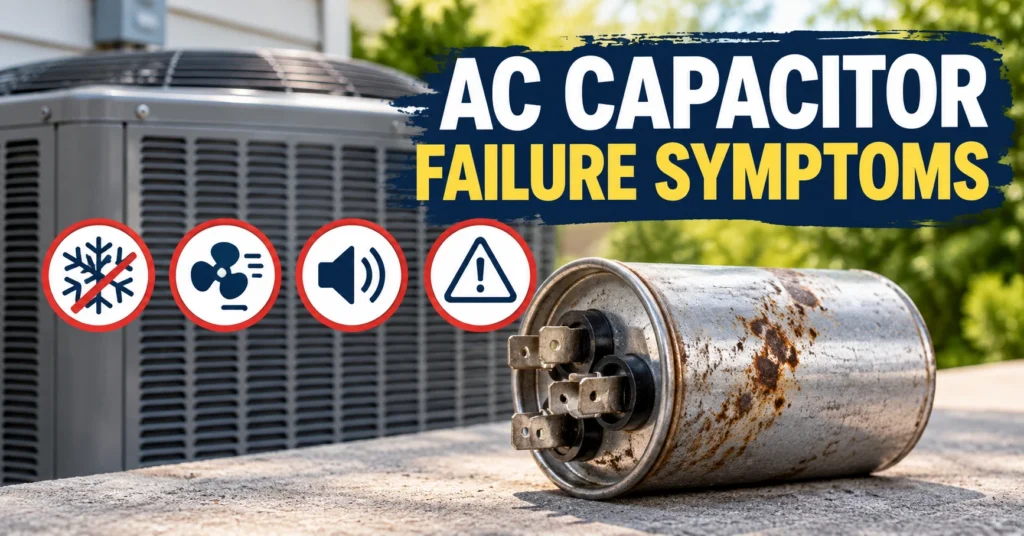
If your air conditioner hums but will not start, blows warm air, or shuts off unexpectedly, a failing AC capacitor could be the problem. This small electrical component helps your air conditioner’s motors start and run properly. When it stops working as intended, your system may struggle to cool your home or stop working altogether.
Common AC capacitor failure symptoms include humming noises, difficulty starting, a non-spinning outdoor fan, reduced cooling, and frequent shutdowns. However, these symptoms can also point to motor, wiring, power supply, or other HVAC problems. A qualified HVAC technician can test the system and identify the actual cause.
Here are seven warning signs of a bad AC capacitor, what they mean, and what you should do if you notice them.
What Are the Symptoms of a Bad AC Capacitor?
The most common symptoms of a failing AC capacitor are a humming outdoor unit, delayed startup, an outdoor fan that does not spin, warm air, unexpected shutdowns, unusual electrical noises, and visible capacitor damage. These signs suggest an electrical or motor problem, but professional testing is necessary to confirm capacitor failure.
| Symptom | What it may indicate | What you should do |
| AC hums but will not start | Capacitor, motor, or electrical fault | Turn off the system and arrange service |
| Outdoor fan does not spin | Failed capacitor, fan motor, or power issue | Stop operating the AC |
| AC struggles to start | Capacitor or another starting-component problem | Schedule an inspection |
| AC blows warm air | Capacitor or another cooling-system issue | Have the system diagnosed |
| AC shuts off unexpectedly | Electrical, motor, or control problem | Arrange professional service |
| Clicking or buzzing sounds | Electrical or mechanical fault | Stop the system if the noise persists or is unusual |
| Bulging or leaking capacitor | Possible capacitor damage | Keep clear and call an HVAC technician |
1. The AC Hums but Won’t Start
A humming sound from the outdoor AC unit without the usual startup is a common warning sign of a possible capacitor problem. The compressor or fan motor may be receiving power but struggling to start.
The capacitor supplies electrical support that helps the motor get moving. If the capacitor weakens or fails, the motor may not generate enough starting torque to operate properly.
You might notice that:
- The outdoor unit makes a steady humming sound.
- The compressor does not start normally.
- The air conditioner stops cooling despite the thermostat calling for cooling.
- The indoor blower continues running while the outdoor unit remains inactive.
However, a failed contactor, damaged motor, or power supply issue can cause similar symptoms. If your air conditioner won’t start, use this guide to explore other AC not turning on troubleshooting steps before arranging a professional inspection.
What should you do? Turn off the air conditioner if the outdoor unit hums without starting. Do not repeatedly switch the system on and off in an attempt to make it work. Contact an HVAC technician to diagnose the fault.
2. The Outdoor AC Fan Won’t Spin
An outdoor fan that does not spin while the unit attempts to operate can indicate a failing capacitor. The fan motor may not be receiving the electrical support it needs to start.
You may hear a humming noise even though the fan blades remain stationary. In other cases, the outdoor unit may be completely silent.
A bad capacitor is only one possible cause. A failed fan motor, electrical supply issue, damaged wiring, or faulty control component can produce similar symptoms.
What should you do? Turn off the AC if the outdoor fan will not run. Do not push the fan blades with a stick or your hand to try to start them. The equipment can contain hazardous electrical components, and the fan may start unexpectedly.
A technician can inspect the fan motor, capacitor, and associated electrical components to determine the cause.
3. Your Air Conditioner Takes Longer to Start
Does your AC take longer than usual to begin cooling after the thermostat calls for it?
A weakening capacitor may make it difficult for the compressor or fan motor to start properly. The system may hesitate, struggle to begin a cooling cycle, or fail to start at all.
You might notice a delay between the thermostat calling for cooling and the outdoor unit starting. You may also hear unusual humming or buzzing during startup.
However, a startup delay does not automatically mean the capacitor is failing. Some systems have built-in time delays to protect the compressor, while thermostat settings, controls, or other electrical faults can also affect startup.
What should you do? If the delay is new, happens repeatedly, or occurs alongside unusual noises, arrange an HVAC inspection. Avoid repeated restart attempts when the system appears to be struggling.
4. The AC Blows Warm Air or Doesn’t Cool Properly
A failing capacitor can interfere with the operation of the compressor or outdoor fan motor. When these components cannot operate correctly, the air conditioner may struggle to remove heat from your home.
Possible warning signs include:
- Air from the vents feels warmer than usual.
- Your home takes longer to reach the thermostat setting.
- The AC runs but does not provide adequate cooling.
- The outdoor unit struggles to start or operate normally.
However, warm air is not specific to capacitor failure. Low refrigerant, restricted airflow, dirty coils, thermostat problems, and compressor faults can also reduce cooling performance.
What should you do? Check that your thermostat is set to COOL and that the temperature setting is appropriate. You can also check your air filter if it is accessible without opening electrical compartments.
If the outdoor unit is humming, the fan is not spinning, or the system continues to blow warm air, turn the system off when an electrical or motor problem is suspected and contact an HVAC professional.
5. Your AC Turns Off Unexpectedly
An air conditioner that repeatedly starts and stops may be experiencing short cycling. A failing capacitor can contribute to operating problems, but it is not the only possible explanation.
Other causes include overheating, refrigerant issues, restricted airflow, faulty controls, and safety switches shutting down the system.
Look for patterns such as:
- The outdoor unit starts and stops more frequently than normal.
- The system struggles to maintain your preferred temperature.
- Cooling stops before your home reaches the thermostat setting.
- The outdoor unit makes unusual noises before shutting down.
Frequent shutdowns can place additional stress on HVAC components, particularly when the compressor repeatedly attempts to restart.
What should you do? Do not keep resetting the system or repeatedly cycling its power. If the shutdowns are new or frequent, arrange a professional inspection so the underlying problem can be identified.
6. You Hear Clicking, Buzzing, or Other Unusual Electrical Noises
Unusual sounds from an air conditioner can indicate a problem with its electrical or mechanical components.
A humming or buzzing sound during startup may occur when a motor struggles to start. Clicking can be associated with a contactor, thermostat, or control issue. A capacitor fault is one possibility, but the sound alone cannot confirm it.
Learn more about the possible causes of AC clicking, buzzing, and humming noises and when these sounds may require professional attention.
Pay attention to when the noise occurs. Does it happen when the thermostat calls for cooling? Does the outdoor unit remain silent after the sound? Does the system shut down shortly afterward?
These details can help an HVAC technician narrow down the possible causes.
What should you do? If you hear persistent buzzing, repeated clicking, or a new electrical noise, turn off the system if it appears to be malfunctioning and arrange professional service. If you notice smoke or a burning smell, keep clear of the equipment and seek urgent professional assistance.
7. The Capacitor Looks Bulged, Leaky, or Burned
A visibly swollen capacitor casing, leaking material, corrosion, or burn marks can indicate component damage.
These signs are not always visible, so a capacitor can fail even when its exterior looks normal. Conversely, visible damage to an electrical component should not be treated as something to repair without proper training.
What should you do? Do not open the outdoor unit’s electrical compartment to look for the capacitor. If you notice damage from a safe distance, keep clear and contact an HVAC technician.
Capacitors can retain a dangerous electrical charge even after the equipment has been disconnected from power. For this reason, testing and replacement should be handled by a qualified professional.
What Does an AC Capacitor Do?
An AC capacitor is an electrical component that stores and releases energy to help an air conditioner’s motors start and operate. Depending on the system design, capacitors may support the compressor motor, the fan motor, or both.
Without a properly functioning capacitor where one is required, a motor may struggle to start or run correctly.
According to Carrier’s AC capacitor guide, capacitors play an important role in starting and maintaining the operation of HVAC motors.
Start Capacitors vs. Run Capacitors
Start and run capacitors serve related but different purposes.
- Start capacitor: Provides additional starting assistance to a motor during startup. It is designed for short periods of operation.
- Run capacitor: Supports the motor during normal operation.
- Dual-run capacitor: Combines support for two motor circuits, commonly the compressor and outdoor fan, in one component.
Not every air conditioner uses the same capacitor arrangement. The correct type depends on the equipment’s design.
A capacitor must match the manufacturer’s specified electrical ratings. Installing an incompatible component can damage equipment or create a safety hazard.
What Causes an AC Capacitor to Fail?
AC capacitors can fail because of age, heat, electrical stress, or other operating conditions. Sometimes, a separate electrical or mechanical problem contributes to the failure.
Age and Normal Component Wear
Capacitors experience electrical and thermal stress during normal operation. Over time, their performance can deteriorate, eventually preventing them from supporting the motor properly.
An older air conditioner may be more likely to need component repairs, but age alone does not confirm capacitor failure.
High Operating Temperatures
Outdoor HVAC equipment is exposed to heat, and elevated operating temperatures can contribute to component deterioration. Poor airflow around the outdoor unit or other equipment problems may also affect operating conditions.
Keep the area around your outdoor condenser clear of obstructions and follow the manufacturer’s maintenance recommendations.
Electrical Surges and Voltage Problems
Electrical surges, voltage irregularities, and faults elsewhere in the system can place stress on electrical components, including capacitors.
If the capacitor fails repeatedly, a technician should investigate whether an underlying electrical problem is contributing to the issue rather than simply replacing the component again.
Motor or Other System Problems
A failing motor, damaged wiring, a faulty contactor, or another electrical problem may produce symptoms that resemble capacitor failure.
This is why an accurate diagnosis matters. Replacing a capacitor without checking the surrounding system may leave the actual problem unresolved.
How Can You Tell If Your AC Capacitor Is Bad?
You can observe several warning signs of a possible capacitor problem, but you cannot reliably confirm capacitor failure from symptoms alone. A qualified HVAC technician can inspect the equipment and test the capacitor against the manufacturer’s specifications.
What Homeowners Can Safely Observe
Without opening electrical compartments, you can note:
- Whether the outdoor unit starts when the thermostat calls for cooling.
- Whether the fan appears to be operating normally.
- Whether the system produces warm air instead of cooling.
- Whether unusual humming, buzzing, or clicking occurs.
- Whether the system repeatedly shuts down.
- Whether you notice smoke or a burning smell.
Record when the problem occurs and whether it happens consistently. This information can help the technician understand the symptoms.
You can also verify your thermostat settings and check an accessible air filter, provided there are no signs of an electrical fault that require you to stop using the system.
How an HVAC Technician Diagnoses a Capacitor Problem
A qualified technician can inspect the electrical components, assess the compressor and fan motor, and test the capacitor using appropriate equipment and safety procedures.
The technician may check:
- The capacitor’s measured capacitance against its specified rating.
- The condition of the compressor and fan motor.
- Electrical connections and the contactor.
- The system’s power supply and controls.
- Whether another fault is causing the symptoms.
A capacitor that tests outside the manufacturer’s acceptable range may need replacement. The technician should also determine whether another issue contributed to the failure.
Is It Safe to Run an AC With a Bad Capacitor?
It is not advisable to keep running an air conditioner when a capacitor failure is suspected, especially if the outdoor fan or compressor is struggling to start. Continued operation can stress affected components and may lead to further damage.
Turn the system off if you notice a humming unit that will not start, a stationary outdoor fan, repeated shutdowns, smoke, or a burning smell. If there is smoke or a burning odor, keep clear of the equipment and seek urgent professional assistance.
Why You Shouldn’t Replace an AC Capacitor Yourself
AC capacitors can retain hazardous electrical energy even after power has been disconnected. Opening the equipment, touching the capacitor, or attempting to discharge or test it can cause serious injury.
Replacement also requires the correct component specifications and proper electrical handling.
The Trane guide to AC capacitors explains why capacitors require careful handling and why homeowners should use a qualified HVAC professional.
For safety, leave capacitor testing and replacement to a trained technician.
AC Capacitor Replacement: What Homeowners Should Know
If a technician confirms that your AC capacitor has failed, replacement is often a component-level repair. However, the final work depends on the equipment design and whether other parts have been affected.
If your technician confirms that the capacitor has failed, understanding the AC capacitor replacement cost can help you prepare for the repair and compare estimates.
What Affects AC Capacitor Replacement Cost?
The cost of replacing an AC capacitor varies by location, equipment type, capacitor specifications, labor, and service-call fees.
Your final quote may depend on:
- The type and rating of the replacement capacitor.
- The accessibility of the component.
- Local labor rates and diagnostic charges.
- Whether additional electrical or motor repairs are needed.
- Whether the visit takes place during an emergency service call.
Ask the HVAC company for an itemized estimate that explains the diagnosis, replacement part, labor, and any additional recommended work.
If the technician discovers another problem during the inspection, review the factors that affect overall AC repair costs to better understand your potential expenses.
Avoid comparing quotes based only on the part price. Correct diagnosis, compatible components, and safe installation are important parts of the repair.
How Long Does AC Capacitor Replacement Take?
A straightforward capacitor replacement may be completed during a single service visit, but the actual time depends on the equipment and the diagnosis.
If the technician discovers a failed motor, damaged wiring, or another electrical problem, additional work may be necessary.
The technician can provide a more accurate time estimate after inspecting the system.
When Should You Schedule AC Service?
Arrange professional service if your AC repeatedly struggles to start, produces unusual electrical noises, fails to cool, or shuts down unexpectedly.
Turn the system off when you suspect an electrical or motor fault rather than repeatedly restarting it. If you notice smoke or a burning smell, keep clear and seek urgent assistance.
Prompt diagnosis can help identify the problem before it causes additional equipment damage.
Frequently Asked Questions About AC Capacitor Failure
What are the first signs of a bad AC capacitor?
Early warning signs can include a humming outdoor unit that struggles to start, delayed startup, reduced cooling, or a fan that does not spin. These symptoms can also indicate other electrical or mechanical faults, so a technician should confirm the cause.
Can a bad AC capacitor cause the AC to blow warm air?
Yes, a faulty capacitor can contribute to poor cooling if it prevents the compressor or outdoor fan motor from operating correctly. However, low refrigerant, restricted airflow, and other component failures can also cause warm air.
Can an AC run with a bad capacitor?
An air conditioner may fail to start or operate incorrectly when a required capacitor is faulty. Do not keep trying to run a system that is struggling to start or has a stationary outdoor fan. Turn it off and arrange professional diagnosis.
How do I know if my AC capacitor is bad without testing it?
You cannot confirm capacitor failure reliably from symptoms alone. Humming, hard starting, warm air, and a non-spinning fan are warning signs, but a technician must inspect the equipment and test the capacitor appropriately to determine whether it has failed.
Is a bad AC capacitor dangerous?
Yes, capacitor handling can be dangerous because capacitors may retain an electrical charge even after power is disconnected. A malfunctioning AC can also present electrical or equipment risks. Do not open the electrical compartment or attempt to test or replace the capacitor yourself.
What causes an AC capacitor to fail?
Common contributing factors include age, heat exposure, electrical surges, voltage problems, and operating stress. Other faults in the motor or electrical system may also contribute, so repeated capacitor failures warrant a broader inspection.
How much does it cost to replace an AC capacitor?
The price varies with the capacitor type, local labor rates, diagnostic fees, and whether other repairs are required. Request a quote from a qualified local HVAC company rather than relying on a national estimate that may not reflect your system or location.
Can a bad capacitor damage an AC compressor?
A faulty capacitor can prevent a motor from starting or running correctly and may place additional stress on the affected components. Continuing to operate a malfunctioning system can increase the risk of further damage. Turn it off and arrange professional diagnosis.
Get Professional Help With AC Capacitor Symptoms
A failing AC capacitor can cause startup problems, unusual humming, reduced cooling, and unexpected shutdowns. However, these symptoms can overlap with other HVAC faults, so an accurate diagnosis is essential.
If your air conditioner is struggling to start, the outdoor fan is not spinning, or your home is not cooling properly, avoid repeatedly restarting the system. A qualified HVAC technician can inspect the equipment, test the capacitor, and determine the right repair.
Need AC repair in the Rowlett or Dallas–Fort Worth area? Arthur Heating & Air has served homeowners in the area since 2005. Contact the team to discuss your AC symptoms and arrange professional service.
Call (469) 589-5571 or visit Arthur Air to request assistance.
Keeping your air conditioner in good working condition starts with recognizing warning signs and addressing problems safely.