
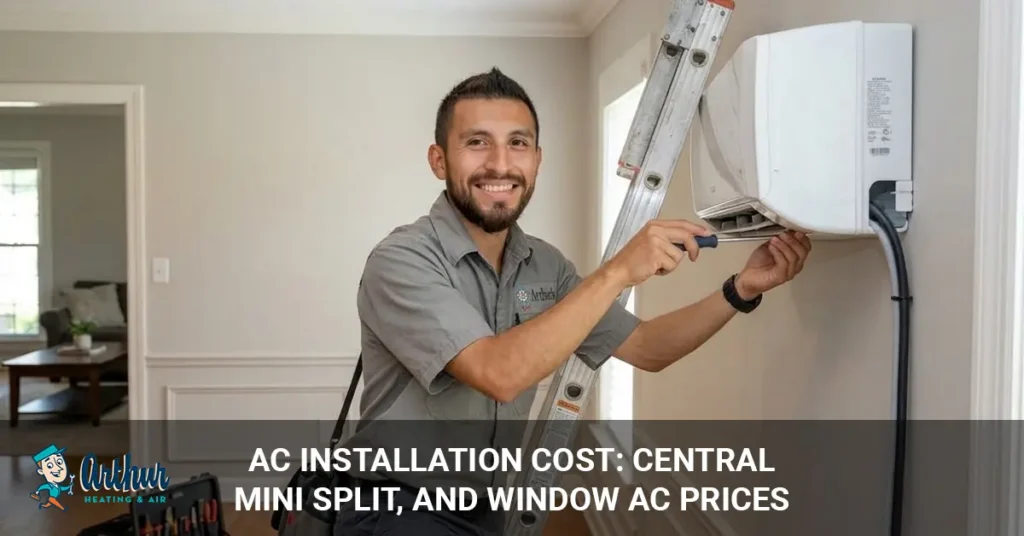
A central AC installation typically costs about $5,000 to $12,000 in 2026, although a straightforward replacement can cost less and a complex new installation can cost considerably more. Your final price depends on the system size, efficiency, labor, ductwork, electrical work, equipment access, and whether you’re replacing an existing system or installing AC for the first time.
The equipment itself is only part of the project. A complete installation may also include the indoor coil, outdoor condenser, refrigerant lines, electrical connections, thermostat, drain work, permits, labor, and startup testing.
Here’s what you can expect to pay and what drives the price.
How Much Does AC Installation Cost?
Most homeowners should budget roughly $5,000 to $12,000 for a central AC installation in 2026, with some projects falling below or above that range.
| Installation Type | Typical Cost Range |
| Central AC replacement | $5,000–$12,000 |
| New central AC installation | $6,000–$15,000+ |
| Ductless mini-split | $2,000–$14,000+ |
| High-efficiency central AC | $6,000–$15,000+ |
| Basic window AC installation | Much lower than central AC |
These are broad planning ranges, not guaranteed quotes. Local labor rates, equipment prices, installation conditions, and the amount of work required can change the final price.
A replacement often costs less than a completely new installation because the home may already have compatible ductwork, electrical connections, refrigerant lines, and drainage.
What Does AC Installation Cost Include?
A complete AC installation quote usually includes the equipment, installation labor, required connections, startup testing, and basic materials, but the exact scope varies by contractor.
A central AC installation may include:
- Outdoor condenser
- Indoor evaporator coil
- Refrigerant lines or line-set work
- Condensate drain connection
- Electrical connections
- Thermostat
- Installation labor
- System startup and testing
- Basic installation materials
Some projects may also require:
- New ductwork
- Electrical panel or circuit upgrades
- New refrigerant lines
- Drain modifications
- Equipment platforms
- Permits
- Attic or crawlspace access work
When comparing estimates, don’t compare the total price alone. Make sure each contractor includes roughly the same scope of work.
AC Installation Cost by System Type
The type of AC system you install has a major effect on the total project price.
Central AC Installation Cost
Central AC installation generally costs more than smaller AC systems because it requires coordinated indoor and outdoor equipment and compatibility with the home’s ductwork.
A central split system typically includes an outdoor condenser and an indoor evaporator coil.
If you’re replacing an existing central AC with a compatible system, the contractor may be able to reuse much of the existing infrastructure.
A new installation can cost more when the home needs ductwork, electrical changes, or other infrastructure.
Ductless Mini-Split Installation Cost
Ductless mini-split installation can cost roughly $2,000 to $14,000 or more depending on the number of indoor units and installation complexity. See our guide to mini-split installation cost for a closer look at the pricing.
A single-zone system usually costs less than a multi-zone system.
Price can increase with:
- Multiple indoor heads
- Long refrigerant lines
- Difficult wall penetrations
- Electrical upgrades
- Multiple outdoor units
- Difficult equipment access
Mini-splits can be useful where installing conventional ductwork isn’t practical.
Window AC Installation Cost
Window AC installation generally costs far less than central AC because the equipment and installation requirements are much simpler.
Many window units require little or no professional installation beyond proper placement and electrical connection.
However, window units don’t provide the same whole-home cooling as a properly designed central system.
If you’re deciding between ductless and central cooling, compare the mini-split vs. central AC cost along with installation requirements and long-term operating costs.
AC Installation Cost by System Size
Larger AC systems generally cost more, but the correct size depends on the home’s cooling load rather than square footage alone.
| AC Size | General Installation Cost Range |
| 1.5 ton | $4,500–$7,000 |
| 2 ton | $5,000–$7,500 |
| 2.5 ton | $5,500–$8,000 |
| 3 ton | $6,000–$9,000 |
| 3.5 ton | $6,500–$9,500 |
| 4 ton | $7,000–$10,500 |
| 5 ton | $8,000–$12,000+ |
These ranges provide a rough planning reference. Actual prices vary by equipment, efficiency, location, labor, and installation requirements.
Don’t choose a larger AC simply because it has more cooling capacity. An oversized system can cycle too frequently and may not remove humidity as effectively.
A contractor should size the system based on the home’s cooling requirements. Choosing the right AC unit for your home also requires considering efficiency, home size, ductwork, and cooling needs.
AC Installation Cost by Efficiency
Higher-efficiency AC systems generally cost more upfront but can use less electricity during operation.
Central air conditioner efficiency is commonly expressed using SEER2, which measures seasonal cooling efficiency. ENERGY STAR defines SEER2 as the amount of heat removed during the cooling season relative to the electrical energy consumed. (ENERGY STAR)
A higher SEER2 rating doesn’t automatically mean the system will save you a specific amount of money. Your savings depend on:
- Electricity rates
- Cooling hours
- Home size
- System size
- Existing equipment efficiency
- Thermostat settings
- Insulation and ductwork
When comparing systems, look at both purchase price and expected operating cost.
What Factors Affect AC Installation Cost?
System size, efficiency, labor, ductwork, electrical work, refrigerant lines, equipment access, and permits can all increase the total installation price.
AC System Size
Higher-capacity equipment generally costs more than smaller equipment.
However, proper sizing matters more than simply choosing the largest system.
An HVAC contractor should determine the appropriate capacity for the home rather than relying only on square footage.
Efficiency Rating
Higher-efficiency systems usually have higher upfront equipment costs.
A more efficient system may make sense when the home has high cooling demand or electricity costs are significant.
Ask the contractor to explain the expected efficiency difference rather than assuming the highest rating automatically offers the best value.
Labor
Labor can account for a significant portion of AC installation costs. Technicians need to remove the old equipment, install the new system, connect the components, test the equipment, and ensure everything operates correctly.
Labor costs vary based on:
- Location
- Contractor
- Installation complexity
- Number of technicians
- Equipment access
- Amount of modification required
Ductwork
Damaged, undersized, poorly designed, or leaking ductwork can add substantially to an AC installation cost.
If the existing ductwork works properly, the contractor may be able to reuse it.
If the ducts have major problems, installing a new AC without addressing them may limit the performance of the new system.
Electrical Work
Electrical upgrades can increase the installation price when the home’s existing electrical service isn’t suitable for the new equipment.
Possible work includes:
- New circuit
- Disconnect replacement
- Wiring changes
- Panel upgrades
Don’t assume electrical work will be necessary. A contractor should inspect the existing setup first.
Refrigerant Lines
A new or difficult-to-route refrigerant line set can increase installation costs.
If the existing lines are compatible and in good condition, the contractor may be able to reuse them.
However, compatibility depends on the equipment and refrigerant requirements.
Thermostat
A basic replacement thermostat may add relatively little to the project, while a smart or communicating thermostat can increase the total cost.
Ask whether the quoted price includes the thermostat.
Location and Accessibility
Equipment installed in a difficult-to-reach attic, crawlspace, rooftop, or tight mechanical area can increase labor costs.
Technicians may need additional time or equipment to safely move and install the system.
Permits
Local permit requirements can add fees to an AC installation project.
Permit rules vary by location.
Ask the contractor whether permit costs are included in the quote or billed separately.
How Much Does It Cost to Replace an AC?
Replacing an existing central AC often costs less than installing a completely new system because the home may already have compatible ductwork, electrical connections, drainage, and refrigerant infrastructure. For a detailed breakdown, see our guide to AC replacement cost.
Here’s the basic difference:
| AC Replacement | New AC Installation |
| Existing ductwork may be reusable | New ductwork may be required |
| Existing electrical may be suitable | Electrical upgrades may be needed |
| Existing lines may be reusable | New lines may be needed |
| Usually less installation work | More site work |
| Lower project complexity | Higher project complexity |
A replacement can still become expensive if the existing system has outdated or incompatible components.
How Much Does a New AC System Cost Without Installation?
The equipment alone can cost several thousand dollars, but the equipment price doesn’t represent the total installed cost.
A central AC system typically requires more than an outdoor condenser.
You may also need:
- Matching indoor coil
- Refrigerant lines
- Thermostat
- Drain components
- Electrical connections
- Installation materials
- Labor
- Testing
That’s why an online equipment price can look much lower than a contractor’s complete installation quote.
When comparing prices, compare installed system with installed system, not equipment-only pricing with a full-service quote.
AC Installation Labor Cost
AC installation labor can represent a substantial portion of the total price, especially when the job involves difficult access, ductwork, electrical work, or other modifications.
A simple replacement with compatible existing infrastructure generally requires less labor than a first-time installation.
The amount of work involved also affects how long the project takes. If you’re planning an AC replacement or a new system installation, see our guide on how long AC installation takes to understand typical timelines and what to expect during the process.
Labor can increase when:
- Equipment is in an attic or crawlspace.
- Ductwork needs modification.
- Electrical work is required.
- The line set needs replacement.
- The old equipment is difficult to remove.
- The installation requires additional workers.
Ask for an itemized quote so you can see what the labor covers.
How to Save Money on AC Installation
The best way to control AC installation costs is to compare complete quotes, choose the correct system size, and avoid paying for unnecessary work.
Get Multiple Written Estimates
Compare at least two or three complete installation quotes for a major AC project.
Don’t compare only the final price.
Check:
- Equipment model
- System size
- Efficiency rating
- Labor
- Warranty
- Ductwork
- Electrical work
- Permit fees
- Startup and testing
Compare Complete Systems
Compare the total installed system rather than shopping for the cheapest outdoor condenser.
A low equipment price doesn’t necessarily mean a lower project cost.
Choose the Correct Size
Proper sizing can help prevent the added cost and comfort problems that come from installing an oversized or undersized system.
ENERGY STAR also warns that bigger isn’t always better and recommends properly sizing air-conditioning equipment. (ENERGY STAR)
Ask About Warranties
Ask what warranties cover the equipment, labor, and replacement parts before approving the installation.
Manufacturer warranties and contractor labor warranties are not necessarily the same thing.
Consider Efficiency Carefully
Choose an efficiency level that makes financial sense for your home’s cooling demand and local electricity rates.
The most efficient system isn’t automatically the best investment if the additional upfront cost is unlikely to provide meaningful savings.
Is AC Installation Worth the Cost?
A new AC installation can make sense when an existing system is old, unreliable, inefficient, or facing a major repair. If replacement is the better option, professional AC installation and replacement can ensure the new system is properly sized and installed.
Replacement may be worth considering when:
- Repairs are becoming frequent.
- Cooling performance has declined.
- Energy costs are increasing.
- Major components are failing.
- The system is approaching the end of its service life.
- Your current system uses outdated technology.
If the existing AC is relatively new and needs only a minor repair, replacing the entire system may not make financial sense.
Compare the repair cost and expected remaining service life before making the decision. Our guide to AC repair vs. replacement can help you weigh the two options.
Frequently Asked Questions
How much does it cost to install an AC?
A central AC installation typically costs about $5,000 to $12,000 in 2026, although complex projects can cost more. System size, efficiency, labor, ductwork, electrical work, and installation conditions affect the final price.
How much does a new AC system cost?
A new central AC system can cost several thousand dollars for the equipment alone, while a complete installed system commonly costs around $5,000 to $12,000 or more.
Always compare complete installed prices when getting quotes.
How much does central AC installation cost?
Central AC installation commonly falls around $5,000 to $12,000, with new installations or complex projects potentially costing more.
Existing ductwork, electrical service, refrigerant lines, and equipment access can make a significant difference.
How much does AC installation labor cost?
AC installation labor varies by location and project complexity and can represent a substantial portion of the total installation price.
Ask for a complete quote rather than estimating labor from hourly rates alone.
How much does it cost to replace an AC?
Replacing an existing central AC commonly costs about $5,000 to $12,000, although the price can be higher when ductwork, electrical work, or other components need replacement.
How much does a 3-ton AC installation cost?
A 3-ton central AC installation may cost roughly $6,000 to $9,000, depending on efficiency, equipment, labor, and installation requirements.
The correct system size should come from a cooling-load assessment rather than the home’s square footage alone.
How much does a 4-ton AC installation cost?
A 4-ton central AC installation may cost roughly $7,000 to $10,500, depending on the equipment and installation conditions.
Don’t choose a 4-ton system simply because a larger system sounds better. Proper sizing matters.
Does AC installation include ductwork?
AC installation doesn’t always include ductwork replacement or modification because many homes already have usable ducts.
Ask the contractor whether the quote includes duct repairs, replacement, sealing, or insulation.
How long does AC installation take?
A straightforward AC replacement can often take one day, while a new installation involving ductwork, electrical changes, or difficult access can take longer.
The contractor should give you a project timeline based on the actual scope of work.
Is AC installation cheaper in winter?
AC installation may be easier to schedule during the off-season, but pricing varies by contractor, demand, equipment, and local promotions.
Don’t assume winter automatically guarantees a lower installation price.
How can I reduce AC installation costs?
Get multiple complete quotes, choose the correctly sized system, compare efficiency carefully, and ask exactly what each quote includes.
Avoid choosing the cheapest quote without checking equipment quality, installation scope, warranty, and contractor experience.
Final Thought
A central AC installation generally costs around $5,000 to $12,000 in 2026, but your actual price depends on much more than the AC unit itself.
The biggest cost factors include system size, efficiency, labor, ductwork, electrical requirements, refrigerant lines, equipment access, and whether you’re replacing an existing system or installing AC for the first time.
Before choosing a contractor, get multiple written estimates and compare the complete scope of work.
Most importantly, don’t choose an AC based only on price or tonnage. Proper sizing, installation quality, efficiency, and warranty coverage can have a bigger effect on the system’s long-term value.
ENERGY STAR notes that properly sizing cooling equipment matters and that a larger unit isn’t necessarily better.