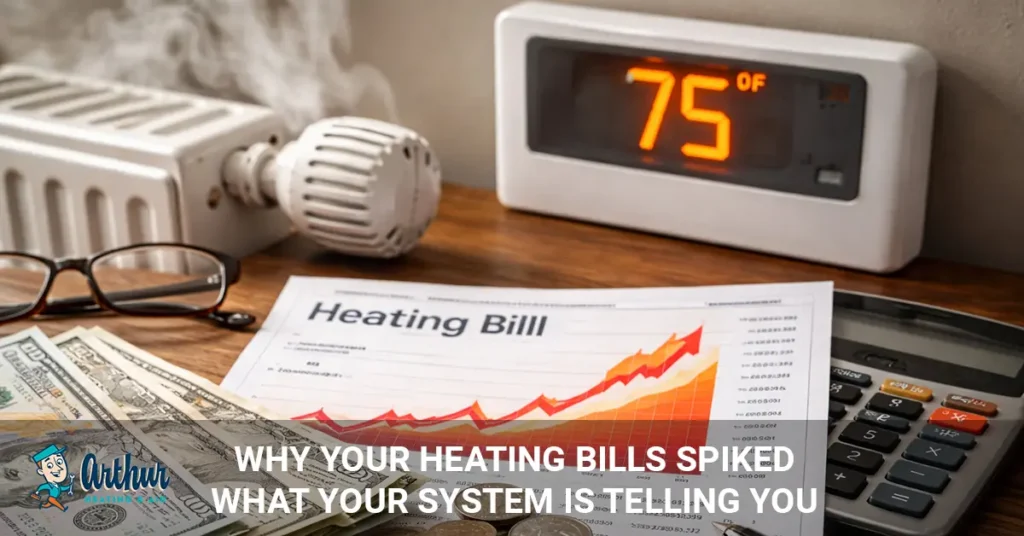
A high heating bill usually means your heater is running more often, your home is losing heat, or your system isn’t operating as efficiently as it should. Colder weather can also increase heating costs even when your HVAC system works normally.
If your bill suddenly jumps, don’t assume you need a new furnace. Start by checking the thermostat, air filter, vents, and obvious drafts. Then compare your energy use with the same period last year.
Here are 10 common reasons your heating bill may be higher than expected and practical ways to lower it.
Why Is My Heating Bill So High?
Your heating bill can increase because of colder weather, higher thermostat settings, restricted airflow, heat loss, duct leaks, an aging HVAC system, or longer furnace runtime.
Use this quick guide to narrow down the cause:
| Cause | Effect on Heating Costs | What to Check |
| High thermostat setting | Longer heating cycles | Thermostat |
| Dirty air filter | Restricted airflow | Filter |
| Poor insulation | More heat loss | Attic and walls |
| Drafty windows/doors | Cold air enters | Air leaks |
| Leaky ductwork | Heated air escapes | Ducts |
| Aging furnace | May use more energy | System condition |
| Poor maintenance | Reduced performance | Service history |
| Blocked vents | Restricted airflow | Registers |
| Thermostat problem | Incorrect cycling | Thermostat |
| Colder weather | More heating demand | Outdoor temperature |
A higher bill doesn’t automatically mean your furnace has failed. First determine whether your energy usage, energy rate, or heating demand changed.
10 Reasons Your Heating Bill Is So High
1. Your Thermostat Is Set Too High
A higher thermostat setting usually makes your heater run longer, which increases energy use.
Your furnace has to replace more heat as you raise the indoor temperature.
If you normally keep the thermostat at 68°F and increase it several degrees, the system will generally need to run longer to maintain that higher temperature.
Instead of making large temperature changes, use a reasonable setting that keeps your home comfortable.
Also check whether the thermostat schedule changed recently. A programming change can cause the furnace to run more than you expect.
2. Your Air Filter Is Dirty
A clogged air filter can restrict airflow and make your furnace run longer to heat the home.
The furnace needs adequate airflow to move heated air through the ductwork.
As dust builds up on the filter, airflow can decrease.
You may notice:
- Weak airflow from vents
- Longer heating cycles
- Uneven temperatures
- Furnace overheating
- More frequent system operation
Check the filter regularly and replace it when it becomes dirty or reaches the manufacturer’s recommended replacement interval. A clogged filter can also affect heating performance, as explained in how a dirty air filter affects your heater.
If a new filter doesn’t improve airflow or heating performance, another HVAC problem may be responsible.
3. Your Home Is Losing Too Much Heat
Poor insulation and air leaks can allow heat to escape faster than your heater can replace it.
Your furnace doesn’t only heat the air. It has to compensate for heat leaving the home.
Common areas for heat loss include:
- Attics
- Exterior walls
- Windows
- Doors
- Basements
- Crawlspaces
- Duct penetrations
If your furnace runs frequently but rooms still feel cold, the problem may involve the building envelope rather than the heating equipment.
Improving insulation and sealing major air leaks can reduce the amount of heat your home loses. Learn more about how insulation affects HVAC performance and why proper insulation matters for heating efficiency.
4. Your Windows or Doors Are Drafty
Gaps around windows and doors can let cold outdoor air into your home and increase heating demand.
You may notice a draft when standing near an exterior door or window.
Check for:
- Cracked or deteriorated caulk
- Damaged weatherstripping
- Gaps around door frames
- Poorly sealed windows
- Light visible around exterior doors
Simple weatherstripping and caulking can help address small leaks.
If the windows themselves are poorly insulated or damaged, the solution may require a larger home improvement project.
5. Your Ductwork Is Leaking
Leaky or poorly insulated ducts can waste heated air before it reaches the rooms that need it.
This becomes especially important when ducts run through unconditioned spaces such as attics, crawlspaces, or garages.
Signs of possible duct problems include:
- Some rooms stay colder than others.
- Airflow varies significantly between rooms.
- The furnace runs for long periods.
- Ducts are visibly damaged or disconnected.
- You notice air escaping around duct connections.
A professional can inspect the ductwork and identify leaks, disconnected sections, or insulation problems.
Sealing and insulating ducts can improve airflow and reduce wasted heating energy. See the benefits of duct sealing for more ways properly sealed ductwork can improve HVAC performance.
6. Your Furnace Is Old or Less Efficient
An aging furnace can contribute to higher heating costs if its efficiency has declined or it has developed operating problems.
But age alone doesn’t prove that your furnace wastes energy.
A well-maintained older furnace can continue working reliably.
Look at the bigger picture:
- How often does it need repairs?
- Does it heat the home evenly?
- Does it run much longer than it used to?
- Have energy costs increased without a change in usage?
- Is the system becoming unreliable?
If an older furnace has frequent problems and rising operating costs, compare the cost of continued repairs with replacement.
7. Your Heater Needs Maintenance
A poorly maintained heating system can lose performance and require longer operation to heat your home.
Dust, restricted airflow, worn components, and other issues can affect how a furnace operates.
Professional maintenance can help identify problems before they become larger repairs. Regular tune-ups can also support efficiency, as explained in how HVAC tune-ups improve energy efficiency.
Maintenance doesn’t guarantee a lower energy bill. Your home’s insulation, weather, thermostat settings, utility rates, and furnace efficiency also matter.
8. Your Vents or Return Grilles Are Blocked
Blocked supply vents and return grilles can restrict airflow and make your heating system work harder.
Walk through your home and check that furniture, curtains, rugs, or other objects aren’t covering vents.
Also make sure supply registers are open.
Your return-air grilles need clear space too. The furnace can’t circulate air properly if the return side is heavily restricted.
This is one of the easiest checks you can make without calling an HVAC technician.
9. Your Thermostat Isn’t Working Properly
A faulty or poorly positioned thermostat can cause the heater to run too long, cycle incorrectly, or read the room temperature inaccurately.
For example, a thermostat located near a drafty window, heat-producing appliance, or direct sunlight may not accurately represent the temperature in the rest of the home.
Check that:
- The thermostat displays the correct temperature.
- Its schedule hasn’t changed.
- Batteries work if required.
- It isn’t located directly near an unusual heat or cold source.
If the thermostat appears to work but the furnace cycles incorrectly, an HVAC technician can test the thermostat and control system.
10. Outdoor Temperatures Are Much Colder
Colder outdoor temperatures naturally increase heating demand and can raise your energy bill even when your furnace operates normally.
Your home loses heat faster when the difference between indoor and outdoor temperatures becomes larger.
For example, a furnace may run much longer during a week of unusually cold weather than it does during a mild winter week.
Before assuming your furnace has a problem, compare:
- Outdoor temperatures
- Heating degree days
- Energy usage
- Thermostat settings
- Utility rates
A higher bill caused by colder weather isn’t necessarily an HVAC failure.
Not Sure Why Your Bill Keeps Going Up?
A professional system check can find hidden inefficiencies quickly.
 Book an Energy Efficiency Check
Why Did My Heating Bill Suddenly Increase?
A sudden increase in your heating bill can result from colder weather, higher energy rates, increased usage, or a change in how your HVAC system operates.
Start by comparing your current bill with the same period from the previous year.
Look at both energy usage and total cost.
For example, if your gas usage stayed similar but the price per unit increased, your furnace may not be the reason for the higher bill.
If your energy usage increased significantly, investigate the heating system and home.
Check:
- Thermostat settings
- Air filter
- Heating runtime
- Outdoor temperatures
- Utility rates
- Airflow
- Drafts
- Ductwork
- Furnace condition
This approach helps separate an HVAC problem from a utility-rate or weather-related increase.
How Can I Lower My Heating Bill?
You can lower heating costs by reducing unnecessary heat loss, maintaining good airflow, using your thermostat wisely, and keeping the heating system in good condition. These strategies can also help lower heating and cooling bills throughout the year.
Replace a Dirty Air Filter
A clean filter helps maintain proper airflow through the HVAC system.
Check it regularly and replace it when needed.
Don’t wait until the filter becomes heavily clogged.
Seal Obvious Air Leaks
Sealing noticeable gaps around doors and windows can reduce unwanted cold-air infiltration.
Weatherstripping and caulk can address many small leaks.
For larger problems, a professional energy audit can identify areas where your home loses significant heat.
Keep Vents Clear
Keeping supply vents and return grilles unobstructed helps maintain proper airflow.
Move furniture, curtains, and other objects away from vents.
Don’t close multiple supply registers in an attempt to save energy. Doing so can affect system airflow.
Improve Insulation
Adequate insulation helps slow heat transfer and allows your home to retain heated air longer.
The attic is an important area to inspect because inadequate attic insulation can contribute to significant heat loss.
If you’re unsure whether your home has enough insulation, consider an energy assessment.
Use the Thermostat Wisely
Avoid unnecessarily high thermostat settings because they make the heater run longer.
Use a comfortable temperature and take advantage of a programmable or smart thermostat if it fits your routine.
Don’t make extreme temperature changes simply to chase a lower bill. Comfort and safe indoor conditions matter too.
Maintain the HVAC System
Regular HVAC maintenance can help keep the heating system operating properly and identify problems that affect performance.
Maintenance may include inspecting airflow, electrical components, blower operation, and other furnace components.
The exact service depends on the heating system and the manufacturer’s requirements.
Seal and Insulate Ductwork
Sealing leaking ducts can reduce the amount of heated air lost before it reaches your rooms.
This is especially useful when ducts run through unconditioned areas.
A professional duct inspection can identify leaks that aren’t obvious from inside the living space.
Does a Dirty Furnace Filter Increase the Heating Bill?
Yes, a dirty furnace filter can contribute to higher heating costs by restricting airflow and making the system run longer.
A clogged filter makes it harder for the HVAC system to move air through the home.
That can reduce heating performance and increase runtime.
However, a dirty filter isn’t the only reason for a high heating bill.
If you replace the filter and your furnace still runs excessively, check for other issues such as duct leaks, poor insulation, thermostat problems, or furnace faults.
Can an Old Furnace Cause a High Heating Bill?
Yes, an older furnace can contribute to higher heating costs if its efficiency has declined or the system has developed performance problems.
But don’t assume that every old furnace wastes excessive energy.
Consider the furnace’s:
- Age
- Efficiency rating
- Maintenance history
- Repair history
- Runtime
- Heating performance
If an older furnace still works reliably and efficiently, replacing it solely because of age may not make financial sense.
If it needs frequent repairs and struggles to heat the home, compare the operating and repair costs with a replacement system.
When Is a High Heating Bill a Sign of an HVAC Problem?
A high heating bill is more likely to indicate an HVAC problem when energy use rises without a clear change in weather or household usage and the system also performs poorly.
Watch for these signs:
- Furnace runs almost constantly.
- Rooms don’t heat evenly.
- Airflow is weak.
- Furnace short cycles.
- System makes unusual noises.
- Heating performance has declined.
- Repair calls have become more frequent.
- Energy consumption suddenly increases.
If your bill rises but the system operates normally during unusually cold weather, the weather may explain the increase.
If both energy use and heating performance change, an HVAC inspection makes more sense.
When Should You Call an HVAC Technician?
Call an HVAC technician when your heating bill stays unusually high and your system shows performance problems that basic checks don’t solve.
Professional service makes sense when:
- The furnace runs almost constantly.
- Airflow remains weak with a clean filter.
- The system repeatedly shuts down.
- The furnace short cycles.
- Rooms remain cold despite long heating cycles.
- You hear unusual noises.
- You notice burning or unusual odors.
- The system requires frequent repairs.
- You suspect a mechanical or electrical problem.
A technician can check the furnace, airflow, ductwork, controls, and other components to identify the cause. Regular HVAC maintenance can also help identify performance issues before they lead to higher heating costs.
Frequently Asked Questions
Why is my heating bill so high all of a sudden?
A sudden increase can come from colder weather, higher utility rates, increased heating use, heat loss, restricted airflow, or an HVAC problem. Compare your energy usage and rate with the same period last year before assuming the furnace is at fault.
Why is my heating bill higher than last year?
Your heating bill may be higher because of colder weather, higher energy rates, increased household usage, or declining HVAC performance. Compare actual energy consumption rather than looking only at the total dollar amount.
Does a dirty furnace filter increase the heating bill?
Yes, a heavily dirty filter can restrict airflow and make the furnace run longer, which may increase energy use. Replace the filter when it becomes dirty and check the system if high runtime continues.
Does an old furnace use more gas?
An older furnace may use more gas if it has lower efficiency or has developed performance problems, but age alone doesn’t determine fuel consumption. Maintenance, efficiency, runtime, and system condition all matter.
How can I lower my heating bill?
Start by maintaining good airflow, replacing dirty filters, sealing obvious drafts, keeping vents clear, using a reasonable thermostat setting, and maintaining the HVAC system.
If the bill remains unusually high, investigate insulation, ductwork, and furnace performance.
What temperature should I set my thermostat to save money?
Use the lowest temperature that keeps your household comfortable and safe rather than relying on one universal setting.
Your home’s insulation, outdoor weather, occupancy, and personal comfort all affect the best setting.
Can leaky ducts increase heating costs?
Yes, leaking ducts can allow heated air to escape before it reaches your living spaces, increasing heating demand.
The effect can be particularly important when ducts run through attics, crawlspaces, or other unconditioned areas.
Why does my furnace run constantly?
A furnace may run constantly because of very cold weather, heat loss, restricted airflow, an undersized system, or a mechanical problem.
Check the filter and thermostat first. If the furnace runs continuously without maintaining the set temperature, have it inspected.
Does insulation affect heating bills?
Yes, inadequate insulation can allow more heat to escape and force your heating system to run longer.
Attics, exterior walls, floors above unconditioned spaces, and other parts of the home’s envelope can affect heat loss.
When should I call an HVAC technician about a high heating bill?
Call an HVAC technician when your energy use rises unexpectedly, and the furnace also runs excessively, heats poorly, cycles incorrectly, or shows other performance problems.
A professional can determine whether the issue comes from the furnace, airflow, controls, or another HVAC component.
Final Thought
A high heating bill doesn’t automatically mean your furnace needs repair or replacement. Colder weather and higher utility rates can raise your costs even when the system works normally.
Start with the simple checks: thermostat settings, air filter, vents, drafts, and obvious airflow problems.
Then compare your energy usage with the same period last year. If your energy use has increased significantly and your furnace also runs longer, heats poorly, or needs frequent repairs, an HVAC inspection can help identify the cause.
The goal isn’t simply to make your furnace run less. The goal is to reduce unnecessary heat loss and help your heating system operate properly while keeping your home comfortable.
Ready to Lower Your Heating Costs for Good?
Get expert service to improve efficiency and reduce energy waste.
 Schedule Heater Service